5.7 Complex Numbers and Their Operations

Learning Objectives

  1. Define the imaginary unit and complex numbers.
  2. Add and subtract complex numbers.
  3. Multiply and divide complex numbers.

Introduction to Complex Numbers

Up to this point the square root of a negative number has been left undefined. For example, we know that −9 is not a real number.

−9=?  or  ( ?)2= −9

There is no real number that when squared results in a negative number. We begin to resolve this issue by defining the imaginary unitDefined as i=−1 where i2=−1., i, as the square root of −1.

             i=−1       and           i2=−1

To express a square root of a negative number in terms of the imaginary unit i, we use the following property where a represents any non-negative real number:

−a=−1⋅a=−1⋅a=ia

With this we can write

−9=−1⋅9=−1⋅9=i⋅3=3i

If −9=3i, then we would expect that 3i squared will equal −9:

(3i)2=9i2=9(−1)=−9 ✓

In this way any square root of a negative real number can be written in terms of the imaginary unit. Such a number is often called an imaginary numberA square root of any negative real number..

Example 1

Rewrite in terms of the imaginary unit i.

  1. −7
  2. −25
  3. −72

Solution:

  1. −7=−1⋅7=−1⋅7=i7
  2.  −25=−1⋅25=−1⋅25=i⋅5=5i
  3.  −72=−1⋅36⋅2=−1⋅36⋅2=i⋅6⋅2=6i2

Notation Note: When an imaginary number involves a radical, we place i in front of the radical. Consider the following:

6i2=62i

Since multiplication is commutative, these numbers are equivalent. However, in the form 62i, the imaginary unit i is often misinterpreted to be part of the radicand. To avoid this confusion, it is a best practice to place i in front of the radical and use 6i2.

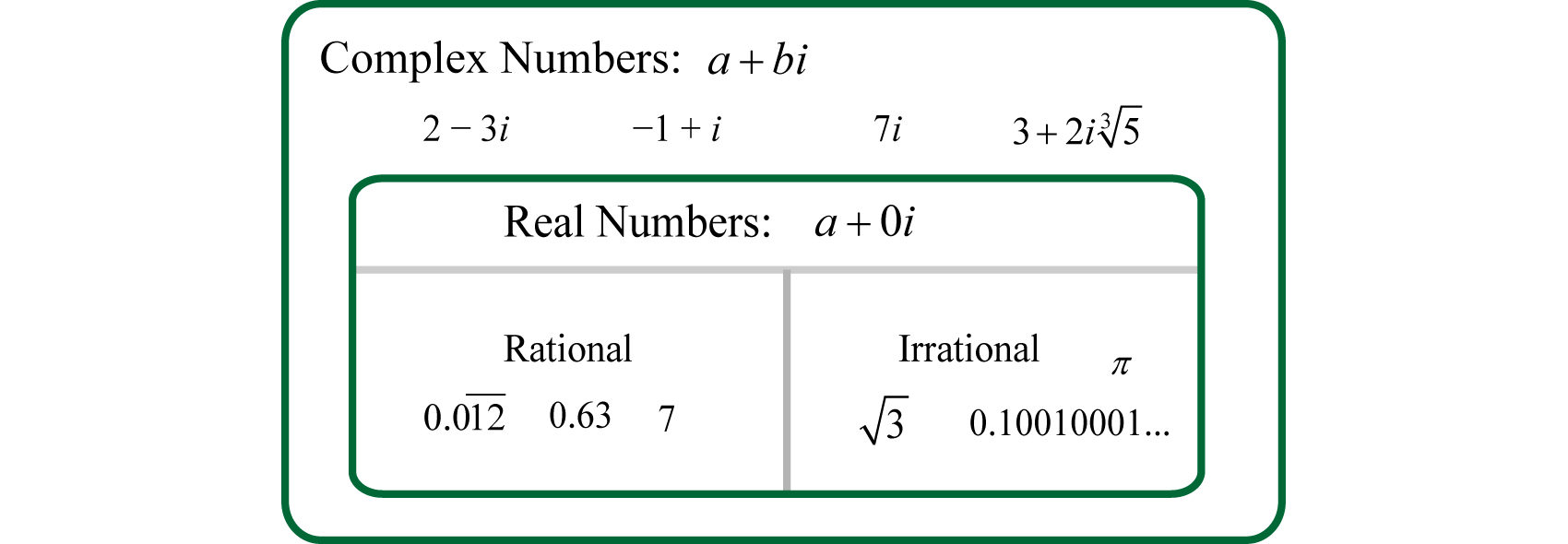
A complex numberA number of the form a+bi, where a and b are real numbers. is any number of the form, a+bi where a and b are real numbers. Here, a is called the real partThe real number a of a complex number a+bi. and b is called the imaginary partThe real number b of a complex number a+bi.. For example, 3−4i is a complex number with a real part of 3 and an imaginary part of −4. It is important to note that any real number is also a complex number. For example, 5 is a real number; it can be written as 5+0i with a real part of 5 and an imaginary part of 0. Hence, the set of real numbers, denoted ℝ, is a subset of the set of complex numbers, denoted ℂ.
ℂ={a+bi|a,b∈ℝ}

Complex numbers are used in many fields including electronics, engineering, physics, and mathematics. In this textbook we will use them to better understand solutions to equations such as x2+4=0. For this reason, we next explore algebraic operations with them.

Adding and Subtracting Complex Numbers

Adding or subtracting complex numbers is similar to adding and subtracting polynomials with like terms. We add or subtract the real parts and then the imaginary parts.

Example 2

Add: (5−2i)+(7+3i).

Solution:

Add the real parts and then add the imaginary parts.

(5−2i)+(7+3i)=5−2i+7+3i=5+7−2i+3i=12+i

Answer: 12+i

To subtract complex numbers, we subtract the real parts and subtract the imaginary parts. This is consistent with the use of the distributive property.

Example 3

Subtract: (10−7i)−(9+5i).

Solution:

Distribute the negative sign and then combine like terms.

(10−7i)−(9+5i)=10−7i−9−5i=10−9−7i−5i=1−12i

Answer: 1−12i

In general, given real numbers a, b, c and d:

(a+bi)+(c+di)=(a+c)+(b+d)i(a+bi)−(c+di)=(a−c)+(b−d)i

Example 4

Simplify: (5+i)+(2−3i)−(4−7i).

Solution:

(5+i)+(2−3i)−(4−7i)=5+i+2−3i−4+7i=3+5i

Answer: 3+5i

In summary, adding and subtracting complex numbers results in a complex number.

Multiplying and Dividing Complex Numbers

Multiplying complex numbers is similar to multiplying polynomials. The distributive property applies. In addition, we make use of the fact that i2=−1 to simplify the result into standard form a+bi.

Example 5

Multiply: −6i(2−3i).

Solution:

We begin by applying the distributive property.

−6i(2−3i)=(−6i)⋅2−(−6i)⋅3iDistribute.=−12i+18i2Substitute i2=−1.=−12i+18(−1)Simplify.=−12i−18=−18−12i

Answer: −18−12i

Example 6

Multiply: (3−4i)(4+5i).

Solution:

(3−4i)(4+5i)=3⋅4+3⋅5i−4i⋅4−4i⋅5iDistribute.=12+15i−16i−20i2Substitute i2=−1. =12+15i−16i−20(−1)=12−i+20=32−i

Answer: 32−i

In general, given real numbers a, b, c and d:

(a+bi)(c+di)=ac+adi+bci+bdi2=ac+adi+bci+bd(−1)=ac+(ad+bc)i−bd=(ac−bd)+(ad+bc)i

Try this! Simplify: (3−2i)2.

Answer: 5−12i

Given a complex number a+bi, its complex conjugateTwo complex numbers whose real parts are the same and imaginary parts are opposite. If given a+bi, then its complex conjugate is a−bi. is a−bi. We next explore the product of complex conjugates.

Example 7

Multiply: (5+2i)(5−2i).

Solution:

(5+2i)(5−2i)=5⋅5−5⋅2i+2i⋅5−2i⋅2i=25−10i+10i−4i2=25−4(−1)=25+4=29

Answer: 29

In general, the product of complex conjugatesThe real number that results from multiplying complex conjugates: (a+bi)(a−bi)=a2+b2. follows:

(a+bi)(a−bi)=a2−a⋅bi+bi⋅a−b2i2=a2−abi+abi−b2(−1)=a2+b2

Note that the result does not involve the imaginary unit; hence, it is real. This leads us to the very useful property

(a+bi)(a−bi)=a2+b2

To divide complex numbers, we apply the technique used to rationalize the denominator. Multiply the numerator and denominator by the conjugate of the denominator. The result can then be simplified into standard form a+bi.

Example 8

Divide: 12−3i.

Solution:

In this example, the conjugate of the denominator is 2+3i. Therefore, we will multiply by 1 in the form (2+3i)(2+3i).

12−3i=1(2−3i)⋅(2+3i)(2+3i)=(2+3i)22+32=2+3i4+9=2+3i13

To write this complex number in standard form, we make use of the fact that 13 is a common denominator.

2+3i13=213+3i13=213+313i

Answer: 213+313i

Example 9

Divide: 1−5i4+i.

Solution:

1−5i4+i=(1−5i)(4+i)⋅(4−i)(4−i)=4−i−20i+5i242+12=4−21i+5(−1)16+1=4−21i−517=−1−21i17=−117−2117i

Answer: −117−2117i

In general, given real numbers a, b, c and d where c and d are not both 0:

(a+bi)(c+di)=(a+bi)(c+di)⋅(c−di)(c−di)=ac−adi+bci−bdi2c2+d2=(ac+bd)+(bc−ad)ic2+d2=(ac+bdc2+d2)+(bc−adc2+d2)i

Example 10

Divide: 8−3i2i.

Solution:

Here we can think of 2i=0+2i and thus we can see that its conjugate is −2i=0−2i.

8−3i2i=(8−3i)(2i)⋅(−2i)(−2i)=−16i+6i2−4i2=−16i+6(−1)−4(−1)=−16i−64=−6−16i4=−64−16i4=−32−4i

Because the denominator is a monomial, we could multiply numerator and denominator by 1 in the form of ii and save some steps reducing in the end.

8−3i2i=(8−3i)(2i)⋅ i  i =8i−3i22i2=8i−3(−1)2(−1)=8i+3−2=8i−2+3−2=−4i−32

Answer: −32−4i

Try this! Divide: 3+2i1−i.

Answer: 12+52i

When multiplying and dividing complex numbers we must take care to understand that the product and quotient rules for radicals require that both a and b are positive. In other words, if an and bn are both real numbers then we have the following rules.

Product rule for radicals:a⋅bn=an⋅bnQuotient rule for radicals:abn=anbn

For example, we can demonstrate that the product rule is true when a and b are both positive as follows:

4⋅9=362⋅3=66=6 ✓

However, when a and b are both negative the property is not true.

−4⋅−9=?362i⋅3i=66i2=6−6=6 ✗

Here −4 and −9 both are not real numbers and the product rule for radicals fails to produce a true statement. Therefore, to avoid some common errors associated with this technicality, ensure that any complex number is written in terms of the imaginary unit i before performing any operations.

Example 11

Multiply: −6⋅−15.

Solution:

Begin by writing the radicals in terms of the imaginary unit i.

−6⋅−15=i6⋅i15

Now the radicands are both positive and the product rule for radicals applies.

−6⋅−15=i6⋅i15=i26⋅15=(−1)90=(−1)9⋅10=(−1)⋅3⋅10=−310

Answer: −310

Example 12

Multiply: −10(−6−10).

Solution:

Begin by writing the radicals in terms of the imaginary unit i and then distribute.

−10(−6−10)=i10(i6−10)=i260−i100=(−1)4⋅15−i100=(−1)⋅2⋅15−i⋅10=−215−10i

Answer: −215−10i

In summary, multiplying and dividing complex numbers results in a complex number.

Try this! Simplify: (2i2)2−(3−i5)2.

Answer: −12+6i5

Key Takeaways

  • The imaginary unit i is defined to be the square root of negative one. In other words, i=−1 and i2=−1.
  • Complex numbers have the form a+bi where a and b are real numbers.
  • The set of real numbers is a subset of the complex numbers.
  • The result of adding, subtracting, multiplying, and dividing complex numbers is a complex number.
  • The product of complex conjugates, a+bi and a−bi, is a real number. Use this fact to divide complex numbers. Multiply the numerator and denominator of a fraction by the complex conjugate of the denominator and then simplify.
  • Ensure that any complex number is written in terms of the imaginary unit i before performing any operations.

Topic Exercises

    Part A: Introduction to Complex Numbers

      Rewrite in terms of imaginary unit i.

    1. −81

    2. −64

    3. −−4

    4. −−36

    5. −20

    6. −18

    7. −50

    8. −48

    9. −−45

    10. −−8

    11. −116

    12. −29

    13. −0.25

    14. −1.44

      Write the complex number in standard form a+bi.

    1. 5−2−4

    2. 3−5−9

    3. −2+3−8

    4. 4−2−18

    5. 3−−246
    6. 2+−7510
    7. −63−5−12
    8. −−72+8−24

      Given that i2=−1 compute the following powers of i.

    1. i3

    2. i4

    3. i5

    4. i6

    5. i15

    6. i24

    Part B: Adding and Subtracting Complex Numbers

      Perform the operations.

    1. (3+5i)+(7−4i)

    2. (6−7i)+(−5−2i)

    3. (−8−3i)+(5+2i)

    4. (−10+15i)+(15−20i)

    5. (12+34i)+(16−18i)

    6. (25−16i)+(110−32i)

    7. (5+2i)−(8−3i)

    8. (7−i)−(−6−9i)

    9. (−9−5i)−(8+12i)

    10. (−11+2i)−(13−7i)

    11. (114+32i)−(47−34i)

    12. (38−13i)−(12−12i)

    13. (2−i)+(3+4i)−(6−5i)

    14. (7+2i)−(6−i)−(3−4i)

    15. (13−i)−(1−12i)−(16+16i)

    16. (1−34i)+(52+i)−(14−58i)

    17. (5−3i)−(2+7i)−(1−10i)

    18. (6−11i)+(2+3i)−(8−4i)

    19. −16−(3−−1)

    20. −100+(−9+7)

    21. (1+−1)−(1−−1)

    22. (3−−81)−(5−3−9)

    23. (5−2−25)−(−3+4−1)

    24. (−12−−1)−(3−−49)

    Part C: Multiplying and Dividing Complex Numbers

      Perform the operations.

    1. i(1−i)

    2. i(1+i)

    3. 2i(7−4i)

    4. 6i(1−2i)

    5. −2i(3−4i)

    6. −5i(2−i)

    7. (2+i)(2−3i)

    8. (3−5i)(1−2i)

    9. (1−i)(8−9i)

    10. (1+5i)(5+2i)

    11. (4+3i)2

    12. (−1+2i)2

    13. (2−5i)2

    14. (5−i)2

    15. (1+i)(1−i)

    16. (2−i)(2+i)

    17. (4−2i)(4+2i)

    18. (6+5i)(6−5i)

    19. (12+23i)(13−12i)
    20. (23−13i)(12−32i)
    21. (2−i)3

    22. (1−3i)3

    23. −2(−2−6)

    24. −1(−1+8)

    25. −6(10−−6)

    26. −15(3−−10)

    27. (2−3−2)(2+3−2)

    28. (1+−5)(1−−5)

    29. (1−3−4)(2+−9)

    30. (2−3−1)(1+2−16)

    31. (2−3i2)(3+i2)

    32. (−1+i3)(2−2i3)

    33. −3i
    34. 5i
    35. 15+4i
    36. 13−4i
    37. 151−2i
    38. 295+2i
    39. 20i1−3i
    40. 10i1+2i
    41. 10−5i3−i
    42. 5−2i1−2i
    43. 5+10i3+4i
    44. 2−4i5+3i
    45. 26+13i2−3i
    46. 4+2i1+i
    47. 3−i2i
    48. −5+2i4i
    49. 1a−bi
    50. ia+bi
    51. 1−−11+−1
    52. 1+−91−−9
    53. −−618+−4
    54. −122−−27

      Given that i−n=1in compute the following powers of i.

    1. i−1

    2. i−2

    3. i−3

    4. i−4

      Perform the operations and simplify.

    1. 2i(2−i)−i(3−4i)

    2. i(5−i)−3i(1−6i)

    3. 5−3(1−i)2

    4. 2(1−2i)2+3i

    5. (1−i)2−2(1−i)+2

    6. (1+i)2−2(1+i)+2

    7. (2i2)2+5

    8. (3i5)2−(i3)2

    9. (2−i)2−(2+i)2

    10. (i3+1)2−(4i2)2

    11. (11+i)2
    12. (11+i)3
    13. (a−bi)2−(a+bi)2

    14. (a2+ai+1)(a2−ai+1)

    15. Show that both −2i and 2i satisfy x2+4=0.

    16. Show that both −i and i satisfy x2+1=0.

    17. Show that both 3−2i and 3+2i satisfy x2−6x+13=0.

    18. Show that both 5−i and 5+i satisfy x2−10x+26=0.

    19. Show that 3, −2i, and 2i are all solutions to x3−3x2+4x−12=0.

    20. Show that −2, 1−i, and 1+i are all solutions to x3−2x+4=0.

    Part D: Discussion Board.

    1. Research and discuss the history of the imaginary unit and complex numbers.

    2. How would you define i0 and why?

    3. Research what it means to calculate the absolute value of a complex number |a+bi|. Illustrate your finding with an example.

    4. Explore the powers of i. Look for a pattern and share your findings.

Answers

  1. 9i

  2. −2i

  3. 2i5

  4. 5i2

  5. −3i5

  6. i4

  7. 0.5i

  8. 5−4i

  9. −2+6i2

  10. 12−63i
  11. 512−74i
  12. −i

  13. i

  14. −i

  1. 10+i

  2. −3−i

  3. 23+58i

  4. −3+5i

  5. −17−17i

  6. −12+94i
  7. −1+8i

  8. −56−23i
  9. 2

  10. −3+5i

  11. 2i

  12. 8−14i

  1. 1+i

  2. 8+14i

  3. −8−6i

  4. 7−4i

  5. −1−17i

  6. 7+24i

  7. −21−20i

  8. 2

  9. 20

  10. 12−136i
  11. 2−11i

  12. −2−2i3

  13. 6+2i15

  14. 22

  15. 20−9i

  16. 12−7i2

  17. 3i

  18. 541−441i
  19. 3+6i

  20. −6+2i

  21. 72−12i
  22. 115−25i
  23. 1+8i

  24. −12−32i
  25. aa2+b2+ba2+b2i
  26. −i

  27. −611−3311i
  28. −i

  29. i

  30. −2+i

  31. 5+6i

  32. 0

  33. −3

  34. −4i2

  35. −i2

  36. −4abi

  37. Proof

  38. Proof

  39. Proof

  1. Answer may vary

  2. Answer may vary