5.3 Adding and Subtracting Radical Expressions

Learning Objectives

  1. Add and subtract like radicals.
  2. Simplify radical expressions involving like radicals.

Adding and Subtracting Like Radicals

Adding and subtracting radical expressions is similar to adding and subtracting like terms. Radicals are considered to be like radicalsRadicals that share the same index and radicand., or similar radicalsTerm used when referring to like radicals., when they share the same index and radicand. For example, the terms 26 and 56 contain like radicals and can be added using the distributive property as follows:

26+56=(2+5)6=76

Typically, we do not show the step involving the distributive property and simply write,

26+56=76

When adding terms with like radicals, add only the coefficients; the radical part remains the same.

Example 1

Add: 753+353.

Solution:

The terms are like radicals; therefore, add the coefficients.

753+353=1053

Answer: 1053

Subtraction is performed in a similar manner.

Example 2

Subtract: 410−510.

Solution:

410−510=(4−5)10=−110=−10

Answer: −10

If the radicand and the index are not exactly the same, then the radicals are not similar and we cannot combine them.

Example 3

Simplify: 105+62−95−72.

Solution:

105+62−95−72=105−95+62−72=  5     −     2

We cannot simplify any further because 5 and 2 are not like radicals; the radicands are not the same.

Answer: 5−2

Caution: It is important to point out that 5−2≠5−2. We can verify this by calculating the value of each side with a calculator.

5−2≈0.825−2=3≈1.73

In general, note that an±bn≠a±bn.

Example 4

Simplify: 5103+310−103−210.

Solution:

5 103+310−103−210=5 103−103+310−210=     4 103 +  10

We cannot simplify any further, because 103 and 10 are not like radicals; the indices are not the same.

Answer: 4103+10

Adding and Subtracting Radical Expressions

Often, we will have to simplify before we can identify the like radicals within the terms.

Example 5

Subtract: 32−18+50.

Solution:

At first glance, the radicals do not appear to be similar. However, after simplifying completely, we will see that we can combine them.

32−18+50=16⋅2−9⋅2+25⋅2=42−32+52=62

Answer: 62

Example 6

Simplify: 1083+243−323−813.

Solution:

Begin by looking for perfect cube factors of each radicand.

1083+243−323−813=27⋅43+8⋅33−8⋅43−27⋅33Simplify.=343+233−243−333Combine like radicals.=43−33

Answer: 43−33

Try this! Simplify: 20+27−35−212.

Answer: −5−3

Next, we work with radical expressions involving variables. In this section, assume all radicands containing variable expressions are nonnegative.

Example 7

Simplify: −95x3−2x3+105x3.

Solution:

Combine like radicals.

−95x3−2x3+105x3=−9 5x3+10 5x3−2x3=5x3−2x3

We cannot combine any further because the remaining radical expressions do not share the same radicand; they are not like radicals. Note: 5x3−2x3≠5x−2x3.

Answer: 5x3−2x3

We will often find the need to subtract a radical expression with multiple terms. If this is the case, remember to apply the distributive property before combining like terms.

Example 8

Simplify: (5x−4y)−(4x−7y).

Solution:

(5x−4y)−(4x−7y)=5x−4y−4x+7yDistribute.=5x−4x−4y+7y=x+3y

Answer: x+3y

Until we simplify, it is often unclear which terms involving radicals are similar. The general steps for simplifying radical expressions are outlined in the following example.

Example 9

Simplify: 53x43+24x33−(x 24x3+4​ ​​3x33).

Solution:

Step 1: Simplify the radical expression. In this case, distribute and then simplify each term that involves a radical.

53x43+24x33−(x 24x3+43x33)=53x43+24x33−x 24x3−43x33=53⋅x⋅x33+8⋅3⋅x33−x 8⋅3x3−43x33=5x 3x3+2x 33−2x 3x3−4x 33

Step2: Combine all like radicals. Remember to add only the coefficients; the variable parts remain the same.

=5x 3x3+2x33−2x 3x3−4​x ​​33=3x 3x3−2x33

Answer: 3x3x3−2x33

Example 10

Simplify: 2a125a2b−a280b+420a4b.

Solution:

2a125a2b−a280b+420a4b=2a25⋅5⋅a2⋅b−a216⋅5⋅b+44⋅5⋅(a2)2bFactor.=2a⋅5⋅a5b−a2⋅45b+4⋅2⋅a25bSimplify.=10a25b−4a25b+8a25bCombine like terms.=14a25b

Answer: 14a25b

Try this! 2x6y3+xy33−(y 27x3−2x2x3y3)

Answer: 3x22y3−2yx3

Tip

Take careful note of the differences between products and sums within a radical. Assume both x and y are nonnegative.

 Products    Sums   x2y2=xyx3y33=xyx2+y2≠x+yx3+y33≠x+y

The property a⋅bn=an⋅bn says that we can simplify radicals when the operation in the radicand is multiplication. There is no corresponding property for addition.

Example 11

Calculate the perimeter of the triangle formed by the points (−2,−1), (−3,6), and (2,1).

Solution:

The formula for the perimeter of a triangle is P=a+b+c where a, b, and c represent the lengths of each side. Plotting the points we have,
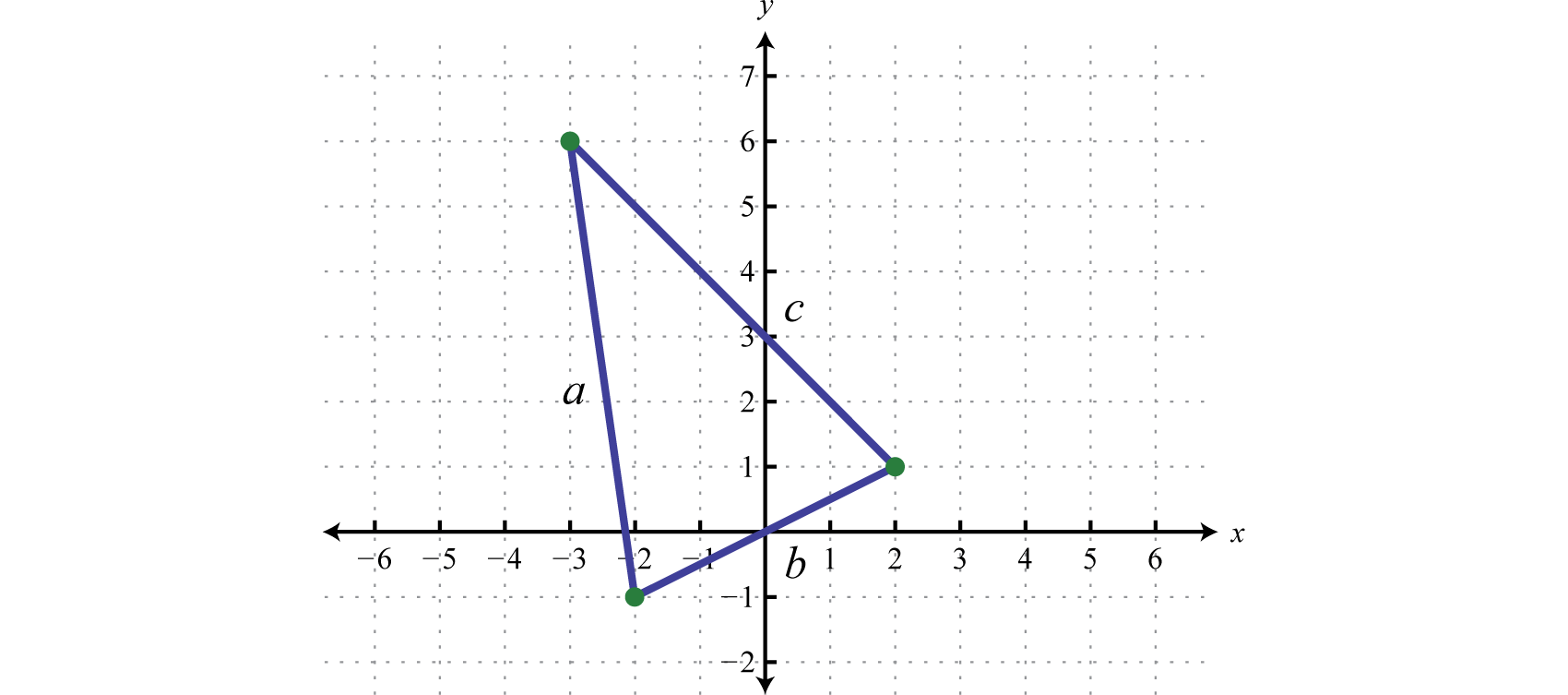
Use the distance formula to calculate the length of each side.

a=[−3−(−2)]2+[6−(−1)]2=(−3+2)2+(6+1)2=(−1)2+(7)2=1+49=50=52   b=[2−(−2)]2+[1−(−1)]2=(2+2)2+(1+1)2=(4)2+(2)2=16+4=20=25

Similarly we can calculate the distance between (−3, 6) and (2,1) and find that c=52 units. Therefore, we can calculate the perimeter as follows:

P=a+b+c=52+25+52=102+25

Answer: 102+25 units

Key Takeaways

  • Add and subtract terms that contain like radicals just as you do like terms. If the index and radicand are exactly the same, then the radicals are similar and can be combined. This involves adding or subtracting only the coefficients; the radical part remains the same.
  • Simplify each radical completely before combining like terms.

Topic Exercises

    Part A: Adding and Subtracting Like Radicals

      Simplify

    1. 103−53

    2. 156−86

    3. 93+53

    4. 126+36

    5. 45−75−25

    6. 310−810−210

    7. 6−46+26

    8. 510−1510−210

    9. 137−62−57+52

    10. 1013−1215+513−1815

    11. 65−(43−35)

    12. −122−(66+2)

    13. (25−310)−(10+35)

    14. (−83+615)−(3−15)

    15. 463−353+663

    16. 103+5103−4103

    17. (793−433)−(93−333)

    18. (−853+253)−(253+6253)

      Simplify. (Assume all radicands containing variable expressions are positive.)

    1. 2x−42x

    2. 53y−63y

    3. 9x+7x

    4. −8y+4y

    5. 7xy−3xy+xy

    6. 10y2x−12y2x−2y2x

    7. 2ab−5a+6ab−10a

    8. −3xy+6y−4xy−7y

    9. 5xy−(3xy−7xy)

    10. −8ab−(2ab−4ab)

    11. (32x−3x)−(2x−73x)

    12. (y−42y)−(y−52y)

    13. 5x3−12x3

    14. −2y3−3y3

    15. a3b5+4a3b5−a3b5

    16. −8ab4+3ab4−2ab4

    17. 62a−42a3+72a−2a3

    18. 43a5+3a3−93a5+3a3

    19. (4xy4−xy3)−(24xy4−xy3)

    20. (56y6−5y)−(26y6+3y)

    21. 2x23x3−(x23x3−x3x3)

    22. 5y36y−(6y−4y36y)

    Part B: Adding and Subtracting Radical Expressions

      Simplify.

    1. 75−12

    2. 24−54

    3. 32+27−8

    4. 20+48−45

    5. 28−27+63−12

    6. 90+24−40−54

    7. 45−80+245−5

    8. 108+48−75−3

    9. 42−(27−72)

    10. −35−(20−50)

    11. 163−543

    12. 813−243

    13. 1353+403−53

    14. 1083−323−43

    15. 227−212

    16. 350−432

    17. 3243−218−48

    18. 6216−224−296

    19. 218−375−298+448

    20. 245−12+220−108

    21. (2363−396)−(712−254)

    22. (2288+3360)−(272−740)

    23. 3543+52503−4163

    24. 41623−23843−37503

      Simplify. (Assume all radicands containing variable expressions are positive.)

    1. 81b+4b

    2. 100a+a

    3. 9a2b−36a2b

    4. 50a2−18a2

    5. 49x−9y+x−4y

    6. 9x+64y−25x−y

    7. 78x−(316y−218x)

    8. 264y−(332y−81y)

    9. 29m2n−5m9n+m2n

    10. 418n2m−2n8m+n2m

    11. 4x2y−9xy2−16x2y+y2x

    12. 32x2y2+12x2y−18x2y2−27x2y

    13. (9x2y−16y)−(49x2y−4y)

    14. (72x2y2−18x2y)−(50x2y2+x2y)

    15. 12m4n−m75m2n+227m4n

    16. 5n27mn2+212mn4−n3mn2

    17. 227a3b−a48ab−a144a3b

    18. 298a4b−2a162a2b+a200b

    19. 125a3−27a3

    20. 1000a23−64a23

    21. 2x54x3−216x43+52x43

    22. x54x33−250x63+x223

    23. 16y24+81y24

    24. 32y45−y45

    25. 32a34−162a34+52a34

    26. 80a4b4+5a4b4−a5b4

    27. 27x33+8x3−125x33

    28. 24x3−128x3−81x3

    29. 27x4y3−8xy33+x64xy3−yx3

    30. 125xy33+8x3y3−216xy33+10xy3

    31. (162x4y3−250x4y23)−(2x4y23−384x4y3)
    32. (32x2y65−243x6y25)−(x2y65−xxy25)

      Calculate the perimeters of the triangles formed by the following sets of vertices.

    1. {(−4, −5), (−4, 3), (2, 3)}

    2. {(−1, 1), (3, 1), (3, −2)}

    3. {(−3, 1), (−3, 5), (1, 5)}

    4. {(−3, −1), (−3, 7), (1, −1)}

    5. {(0,0), (2,4), (−2,6)}

    6. {(−5,−2), (−3,0), (1,−6)}

    7. A square garden that is 10 feet on each side is to be fenced in. In addition, the space is to be partitioned in half using a fence along its diagonal. How much fencing is needed to do this? (Round to the nearest tenth of a foot.)

    8. A garden in the shape of a square has an area of 150 square feet. How much fencing is needed to fence it in? (Hint: The length of each side of a square is equal to the square root of the area. Round to the nearest tenth of a foot.)

    Part C: Discussion Board

    1. Choose values for x and y and use a calculator to show that x+y≠x+y.

    2. Choose values for x and y and use a calculator to show that x2+y2≠x+y.

Answers

  1. 53

  2. 143

  3. −55

  4. −6

  5. 87−2

  6. 95−43

  7. −5−410

  8. 1063−353

  9. 693−33

  10. −32x

  11. 16x

  12. 5xy

  13. 8ab−15a

  14. 9xy

  15. 22x+63x

  16. −7x3

  17. 4a3b5

  18. 132a−52a3

  19. −4xy4

  20. x23x3+x3x3

  1. 33

  2. 22+33

  3. 57−53

  4. 55

  5. 102−33

  6. −23

  7. 453

  8. 23

  9. 233−62

  10. −82+3

  11. 83−66

  12. 2623

  13. 11b

  14. −3ab

  15. 8x−5y

  16. 202x−12y

  17. −8mn

  18. −2xy−2yx

  19. −4xy

  20. 3m23n

  21. 2a3ab−12a2ab

  22. 2a3

  23. 7x2x3

  24. 5y24

  25. 42a34

  26. −2x+2x3

  27. 7xxy3−3yx3

  28. 7x6xy3−6x2xy23

  29. 24 units

  30. 8+42 units

  31. 45+210 units

  32. 54.1 feet

  1. Answer may vary