When multiplying fractions, we can multiply the numerators and denominators together and then reduce, as illustrated:

Multiplying rational expressions is performed in a similar manner. For example,

In general, given polynomials P, Q, R, and S, where and , we have

In this section, assume that all variable expressions in the denominator are nonzero unless otherwise stated.
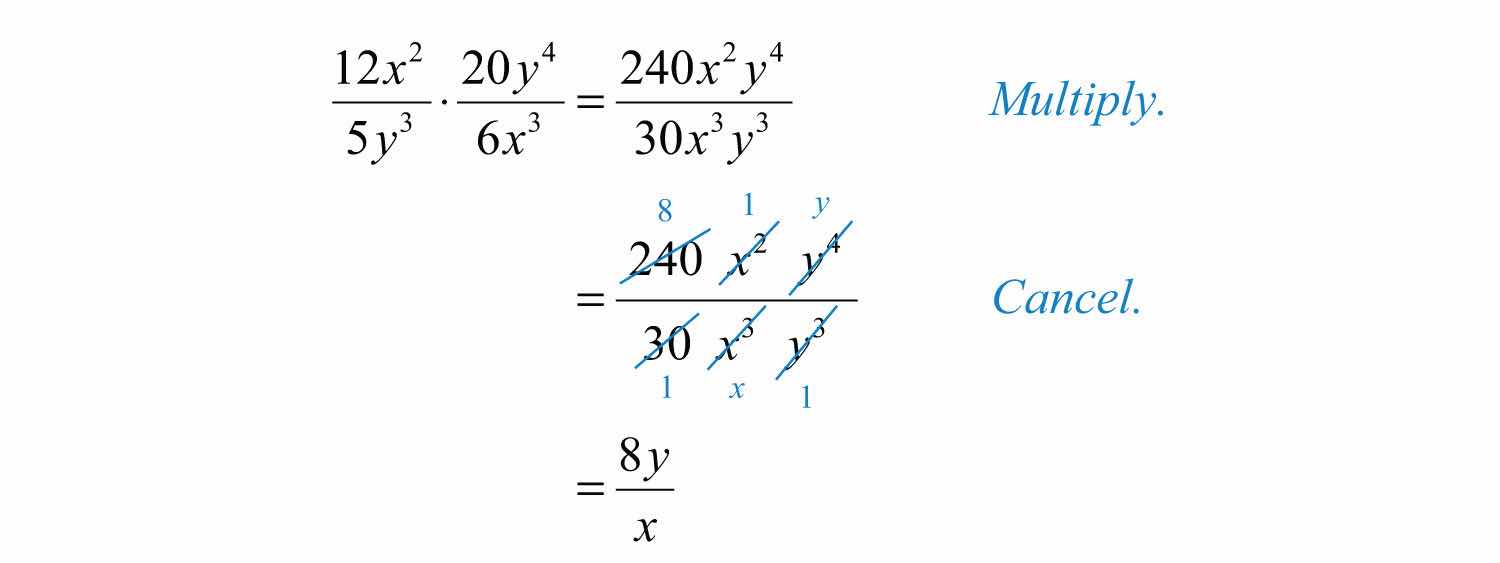
Example 1: Multiply: .
Solution: Multiply numerators and denominators and then cancel common factors.
Answer:
Example 2: Multiply: .
Solution: Leave the product in factored form and cancel the common factors.

Answer:
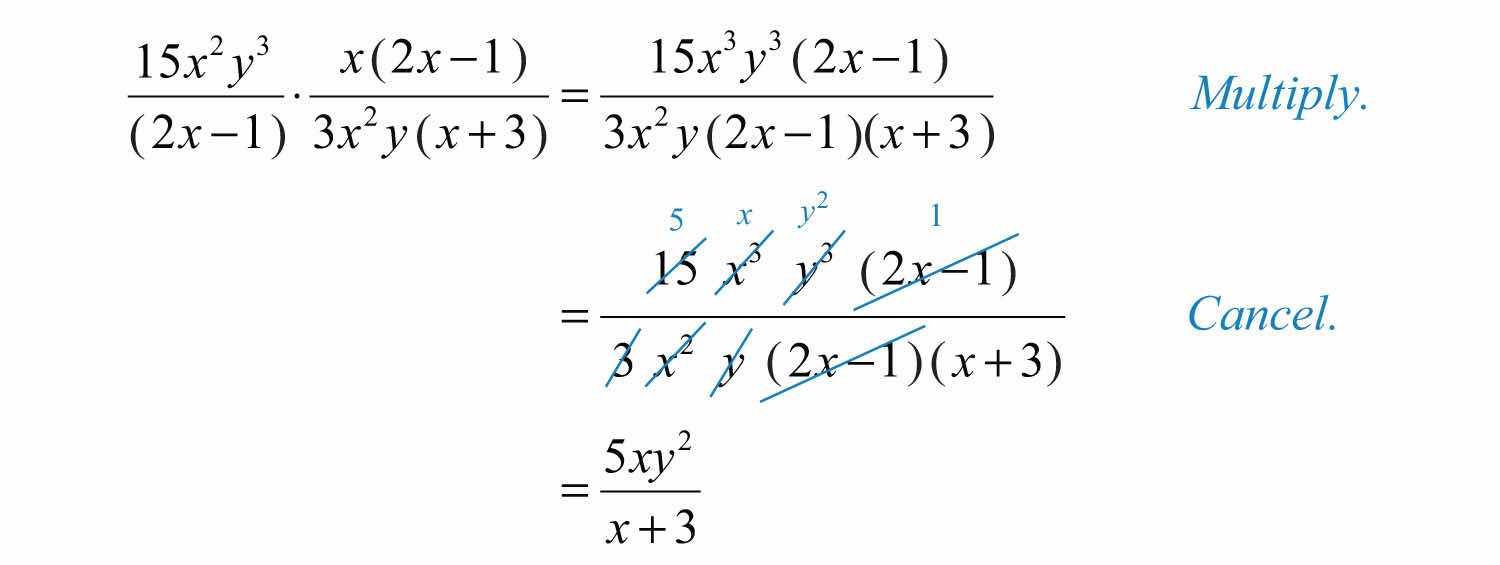
Example 3: Multiply: .
Solution: Leave the polynomials in the numerator and denominator factored so that we can cancel the factors. In other words, do not apply the distributive property.
Answer:
Typically, rational expressions will not be given in factored form. In this case, first factor all numerators and denominators completely. Next, multiply and cancel any common factors, if there are any.
Example 4: Multiply: .
Solution: Factor the denominator as a difference of squares. Then multiply and cancel.
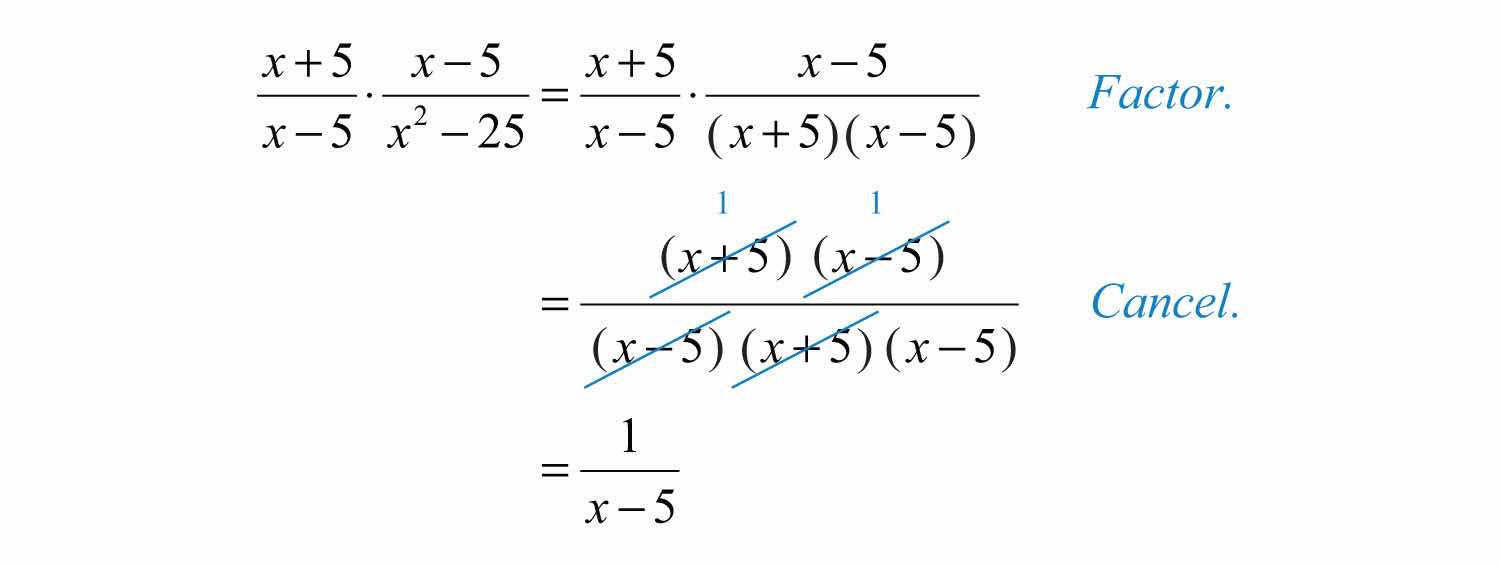
Keep in mind that 1 is always a factor; so when the entire numerator cancels out, make sure to write the factor 1.
Answer:
Example 5: Multiply: .
Solution:
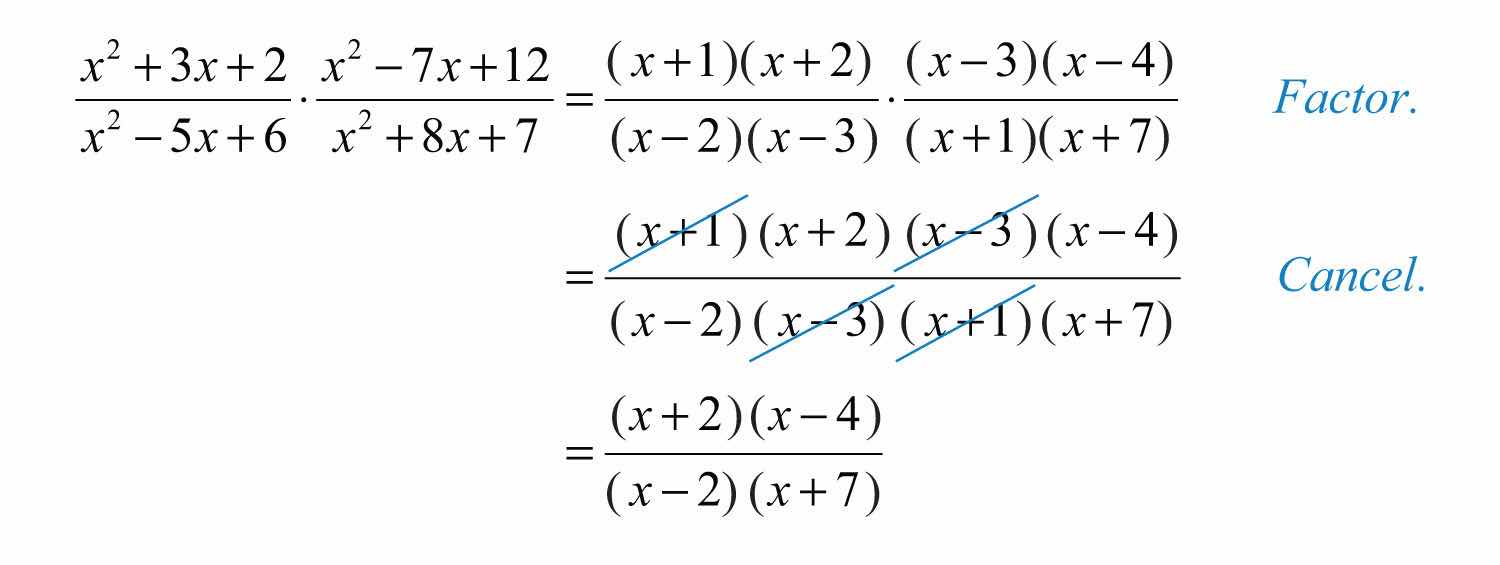
It is a best practice to leave the final answer in factored form.
Answer:
Example 6: Multiply: .
Solution: The trinomial in the numerator has a negative leading coefficient. Recall that it is a best practice to first factor out a −1 and then factor the resulting trinomial.
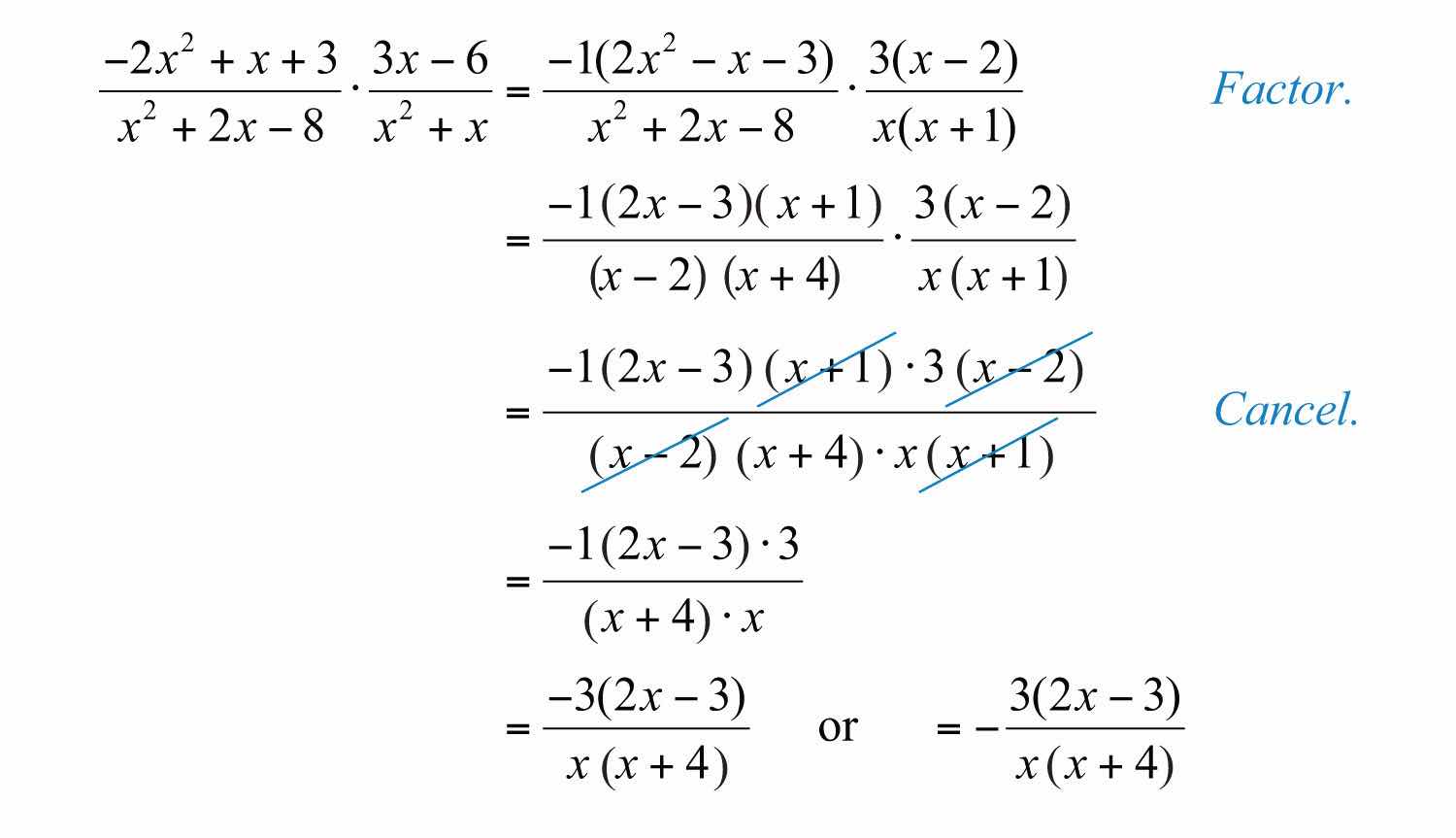
Answer:
Example 7: Multiply: .
Solution: We replace with so that we can cancel this factor.
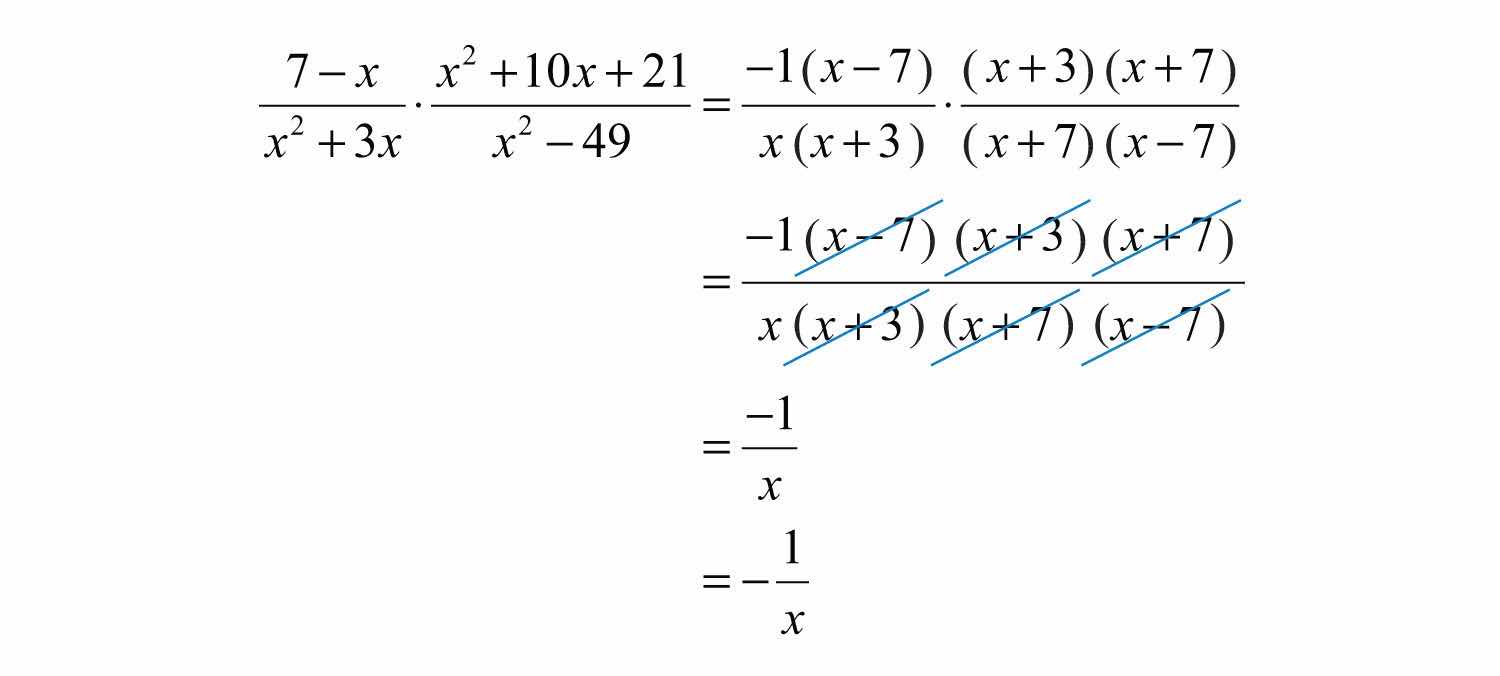
Answer:
Try this! Multiply: .
Answer:
To divide two fractions, we multiply by the reciprocal of the divisor, as illustrated:

Dividing rational expressions is performed in a similar manner. For example,

In general, given polynomials P, Q, R, and S, where , , and , we have

Example 8: Divide: .
Solution: First, multiply by the reciprocal of the divisor and then cancel.
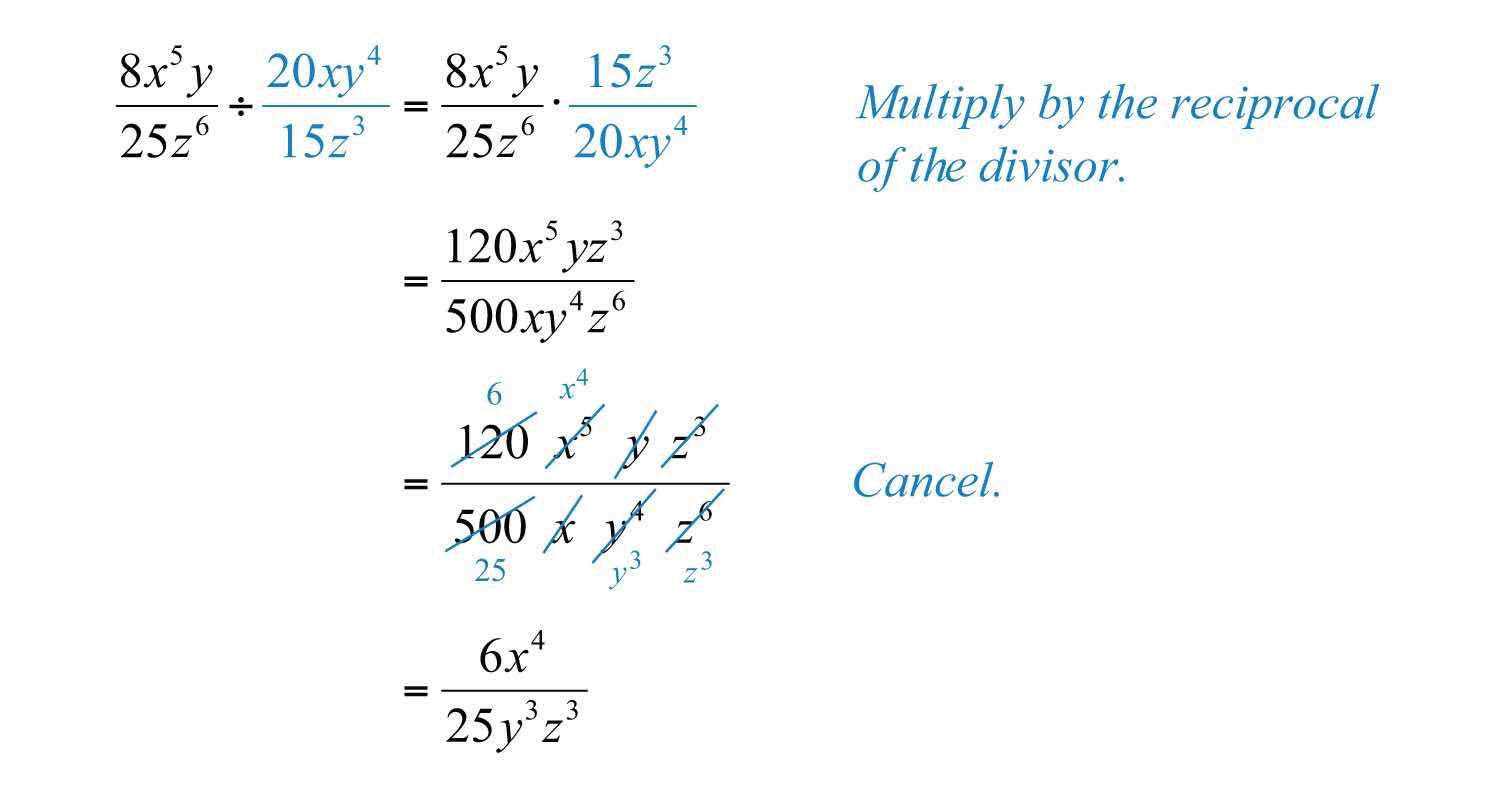
Answer:
Example 9: Divide: .
Solution: After multiplying by the reciprocal of the divisor, factor and cancel.
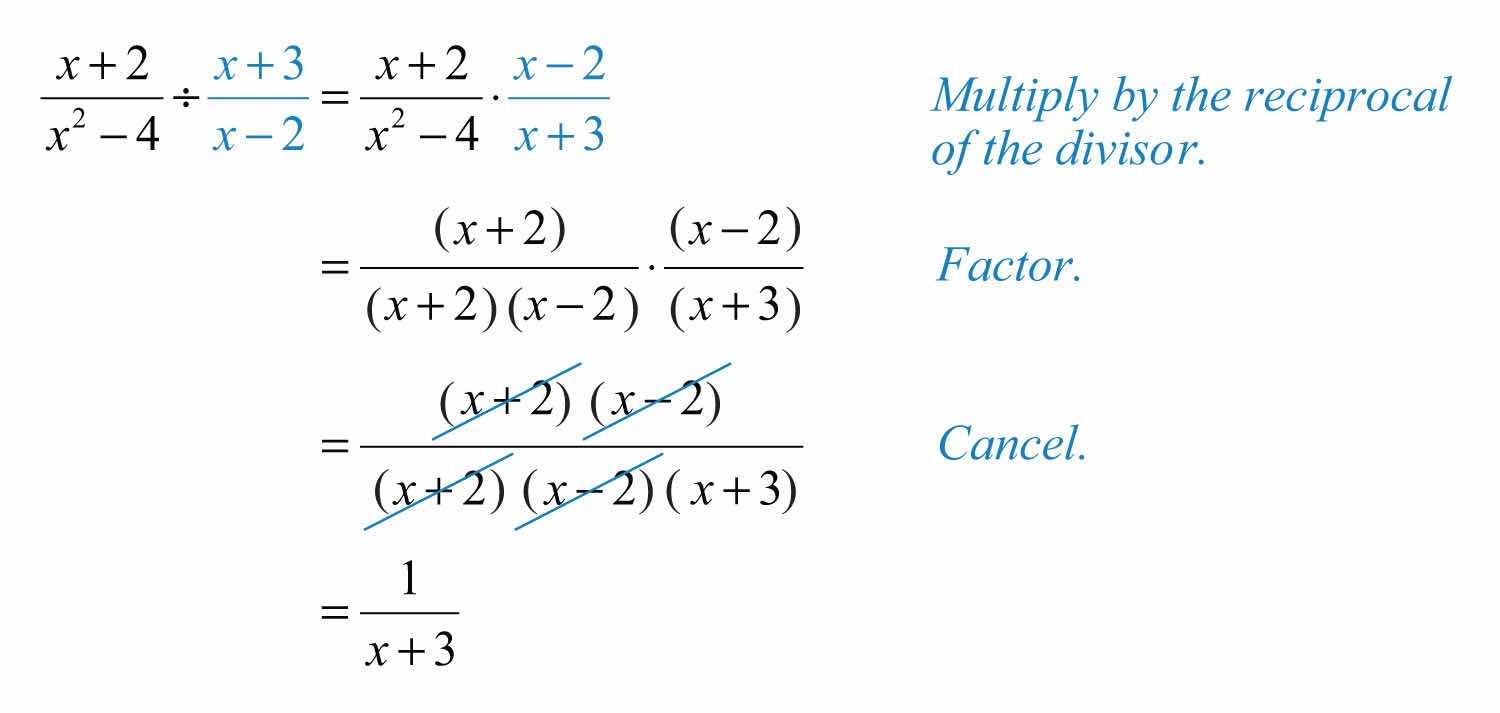
Answer:
Example 10: Divide: .
Solution: Begin by multiplying by the reciprocal of the divisor. After doing so, factor and cancel.
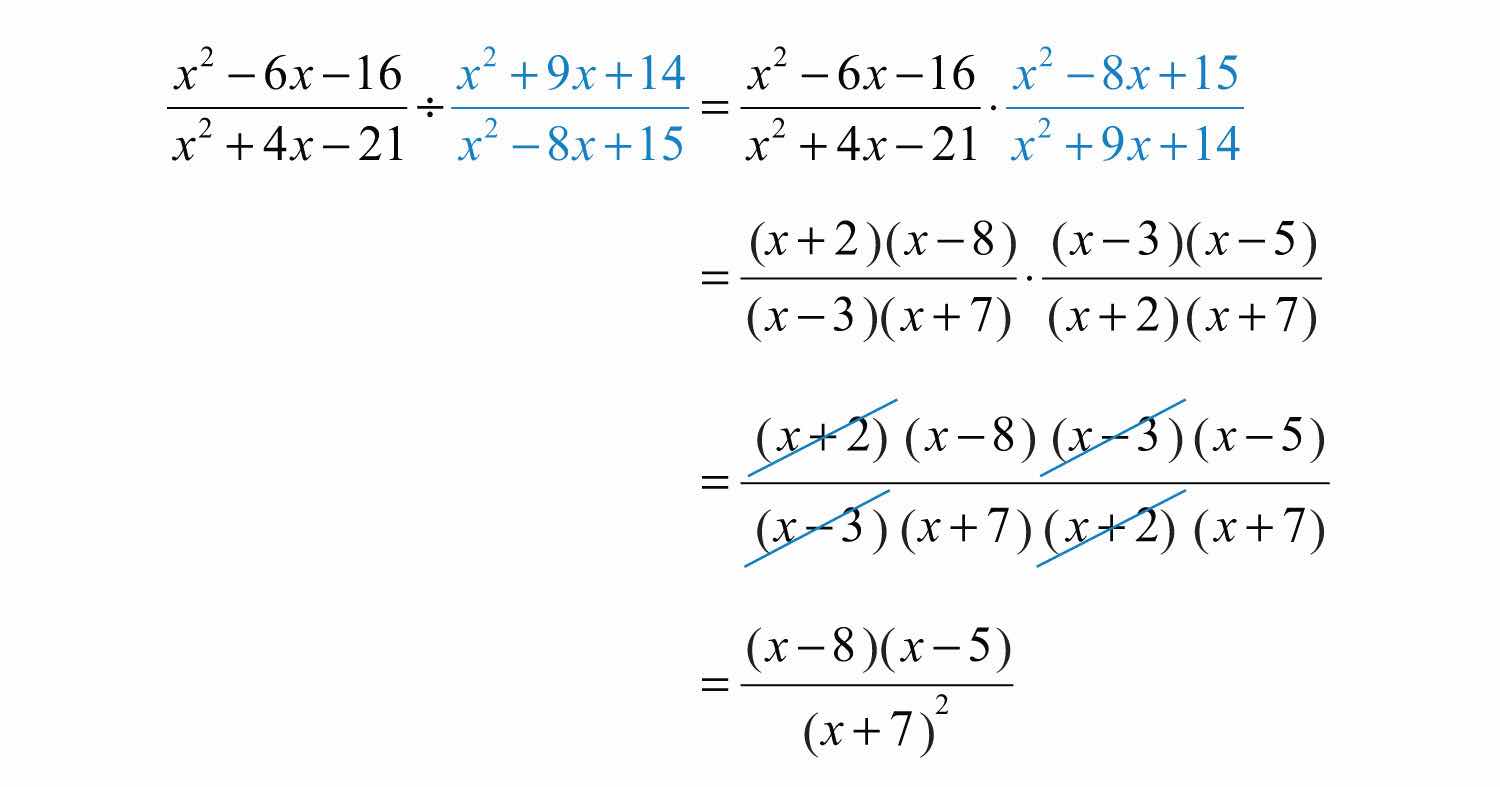
Answer:
Example 11: Divide: .
Solution: Just as we do with fractions, think of the divisor as an algebraic fraction over 1.
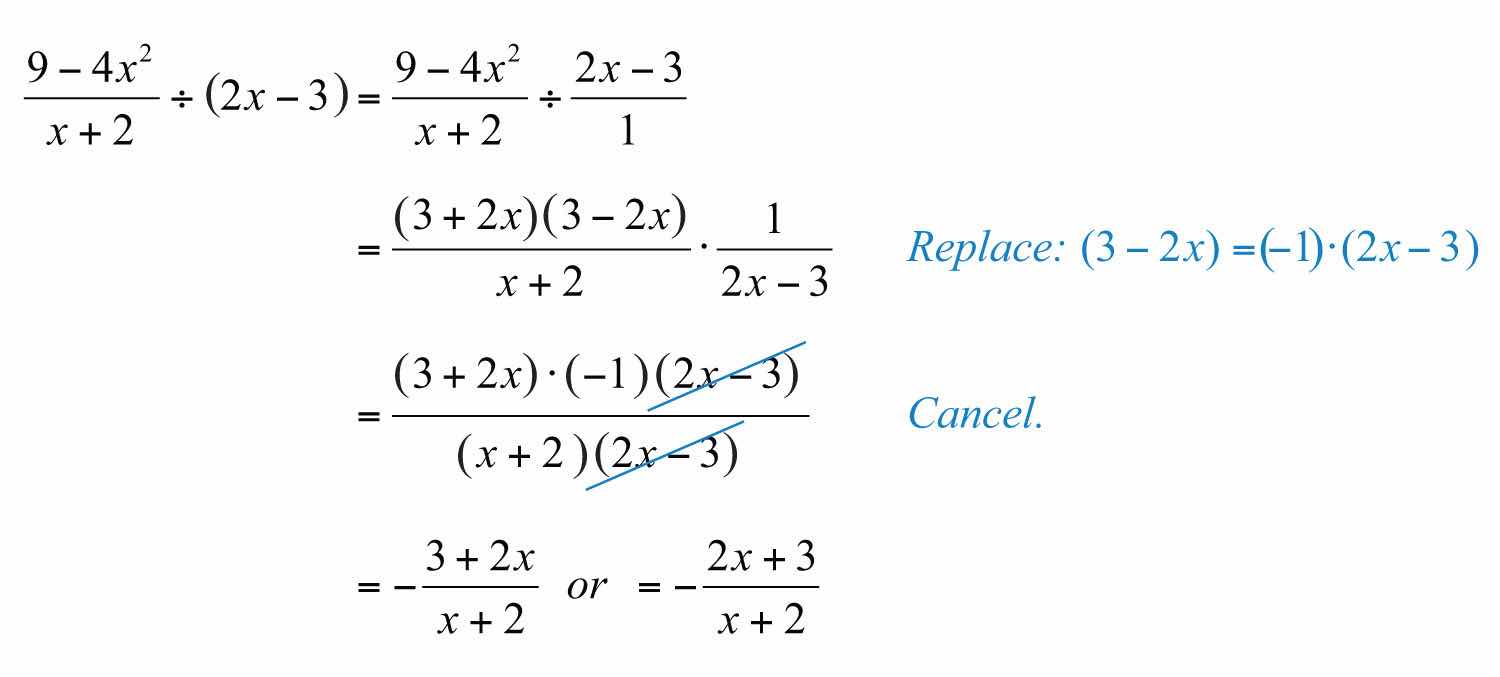
Answer:
Try this! Divide: .
Answer:
The product and quotient of two rational functions can be simplified using the techniques described in this section. The restrictions to the domain of a product consist of the restrictions of each function.
Example 12: Calculate and determine the restrictions to the domain.

Solution: In this case, the domain of consists of all real numbers except 0, and the domain of consists of all real numbers except 1/4. Therefore, the domain of the product consists of all real numbers except 0 and 1/4. Multiply the functions and then simplify the result.
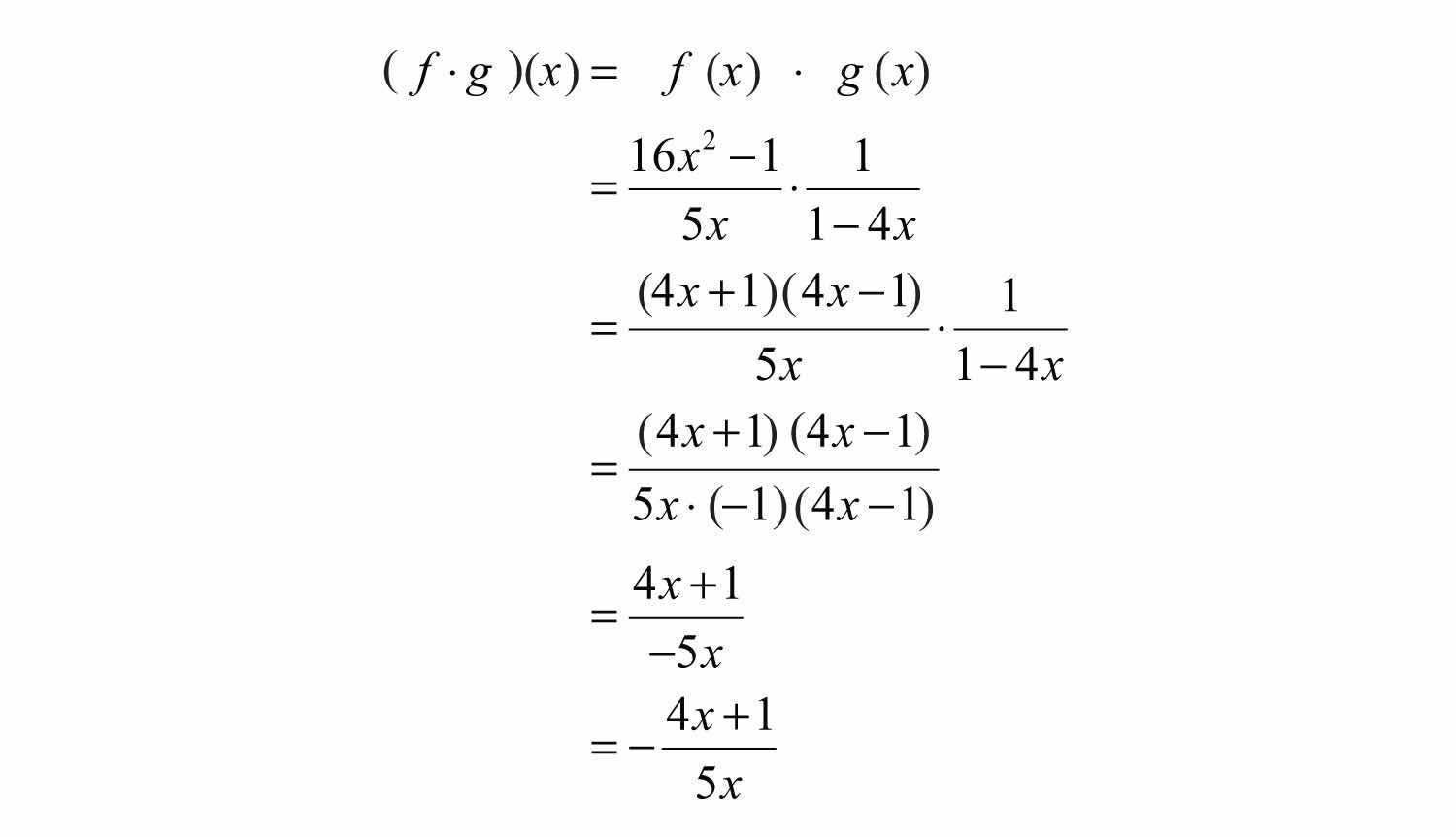
Answer: , where
The restrictions to the domain of a quotient will consist of the restrictions of each function as well as the restrictions on the reciprocal of the divisor.
Example 13: Calculate and determine the restrictions.

Solution:
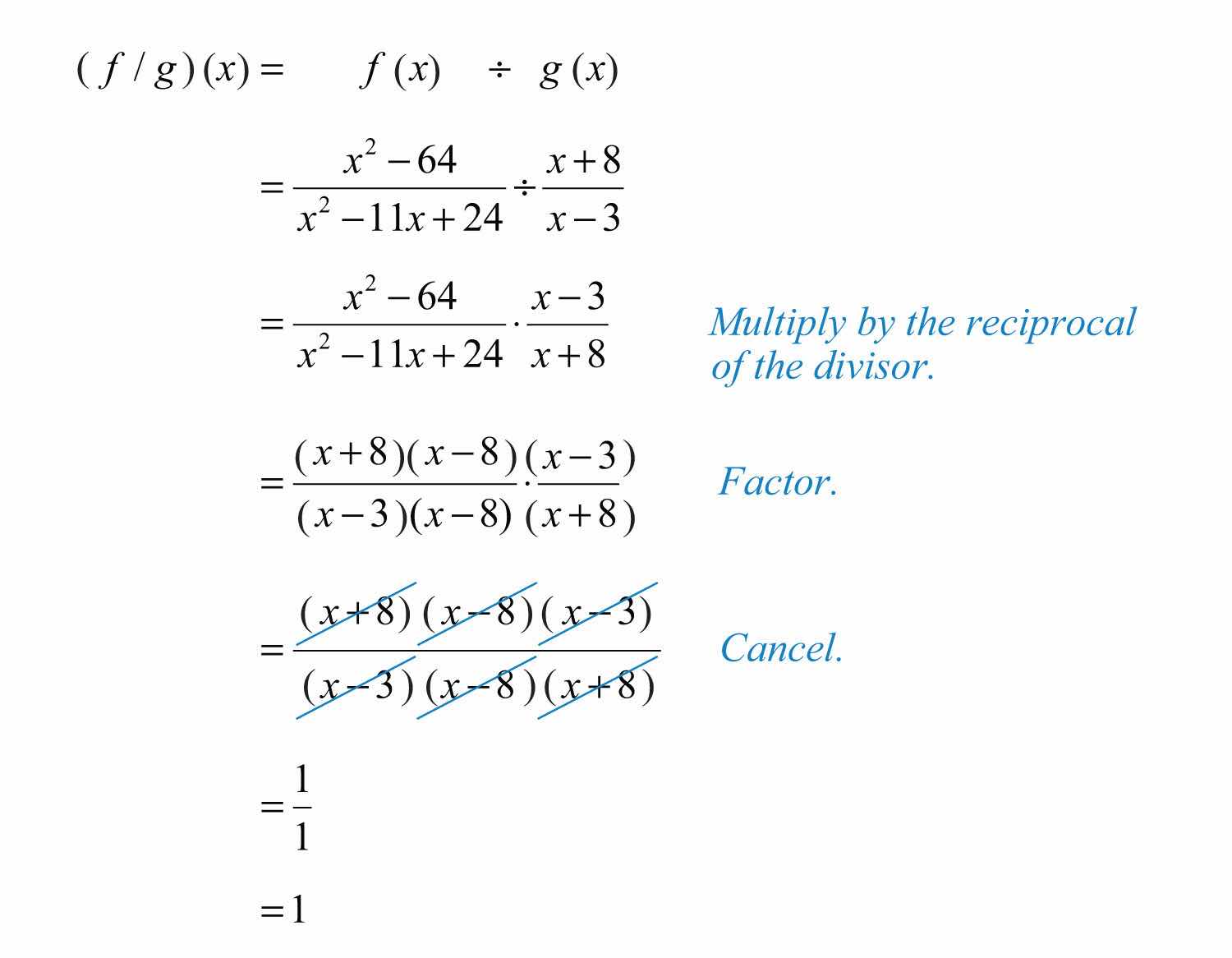
In this case, the domain of consists of all real numbers except 3 and 8, and the domain of consists all real numbers except 3. In addition, the reciprocal of has a restriction of −8. Therefore, the domain of this quotient consists of all real numbers except 3, 8, and −8.
Answer: , where
Part A: Multiplying Rational Expressions
Multiply. (Assume all denominators are nonzero.)
1.
2.
3.
4.
5.
6.
7.
8.
9.
10.
11.
12.
13.
14.
15.
16.
17.
18.
19.
20.
21.
22.
23.
24.
25.
26.
Part B: Dividing Rational Expressions
Divide. (Assume all denominators are nonzero.)
27.
28.
29.
30.
31.
32.
33.
34.
35.
36.
37.
38.
39.
40.
41.
42.
43.
44.
45.
46.
47.
48.
49.
50.
51.
52.
53.
54.
55.
56.
57.
58.
Recall that multiplication and division are to be performed in the order they appear from left to right. Simplify the following.
59.
60.
61.
62.
63.
64.
Part C: Multiplying and Dividing Rational Functions
Calculate and determine the restrictions to the domain.
65. and
66. and
67. and
68. and
69. and
70. and
Calculate and state the restrictions.
71. and
72. and
73. and
74. and
75. and
76. and
Part D: Discussion Board Topics
77. In the history of fractions, who is credited for the first use of the fraction bar?
78. How did the ancient Egyptians use fractions?
79. Explain why is a restriction to .
1:
3:
5:
7:
9:
11:
13: −1
15:
17:
19:
21:
23:
25: 2/3
27:
29:
31:
33:
35:
37:
39:
41:
43:
45:
47:
49:
51:
53:
55:
57: −1/4
59:
61:
63:
65: ;
67: ;
69: ;
71: ;
73: ;
75: ;


