Word 2010
Text Boxes and WordArt

Introduction

You may want to insert a text box into your document to draw attention to specific text or have the ability to easily move text within a document. Text boxes are basically treated the same as shapes , so you can add the same types of effects to them and can even change their shape.
In this lesson, you will learn how to insert a text box and format it in various ways, including resizing and moving it, as well as changing the text box shape , color , and outline . You will also learn how to create and format WordArt .
Text boxes
Text boxes are useful for helping to organize your document. They are basically treated the same as shapes , so when you i nsert a text box you can format it by changing its fill color , outline color , and shape style , as well as create WordArt and add 3D effects .
To insert a text box:
- Select the Insert tab on the Ribbon.
- Click the Text Box command in the Text group. A drop-down menu will appear.
-
Select
Draw Text Box
.
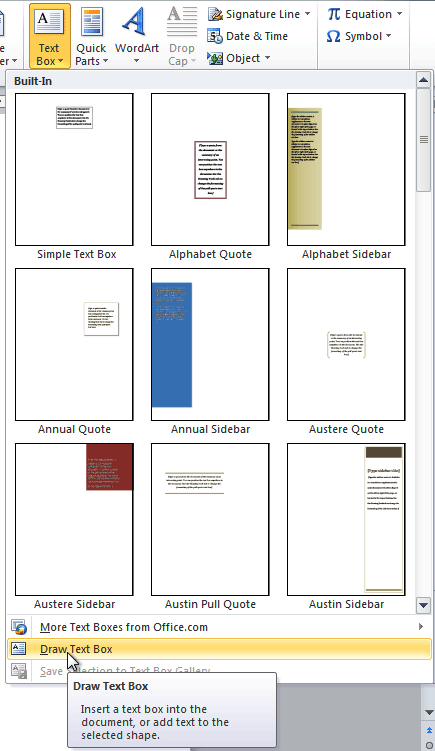 Creating a blank text box
-
Click and drag on the document to create the text box.
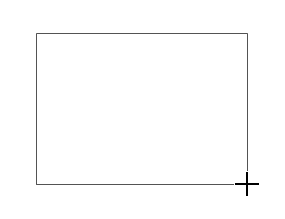 Drawing the text box
- You can now start typing to create text inside the text box.
From the drop-down menu, you can also select one of the built-in text boxes that have predefined colors, fonts, positions, and sizes. If you choose this option, the text box will appear automatically so you will not need to click and drag to draw it.
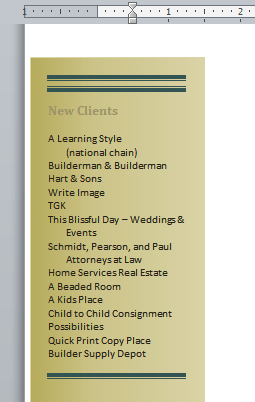 A built-in text box
To move a text box:
- Click the text box.
-
Hover the mouse over one of the edges of the text box. The mouse pointer becomes a
cross with arrows
on each end
 .
.
-
Click and drag
the text box to the desired location on the page.
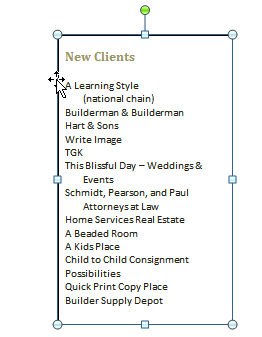 Moving a text box
To resize a text box:
- Click the text box.
-
Click and drag one of the
sizing handles
on the corners or sides of the text box until it is the desired size.
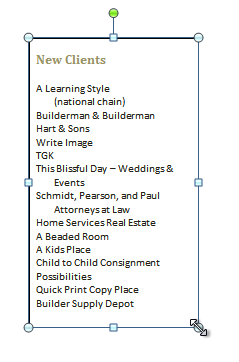 Resizing a text box
If you drag the sizing handles on any of the four corners, you will be able to change the height and width at the same time. The sizing handles on the top or bottom of the text box will only allow you to resize vertically , while the handles on the left and right sides will resize the text box horizontally .
Changing a text box's appearance
To change the text box shape:
- Select the text box. A new Format tab appears with Drawing Tools .
- Go to the Format tab.
-
Click the
Edit Shape
command.
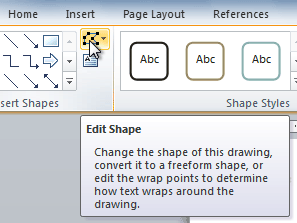 The Edit Shape command
-
Click
Change Shape
to display a drop-down list.
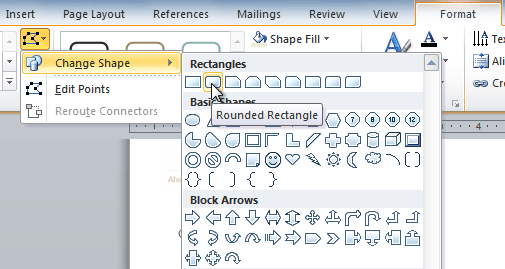 Choosing a different shape for the text box
- Select the desired shape from the list.
To choose a shape style:
Choosing a shape style allows you to apply a preset fill and outline color, and in some cases other effects such as beveling and shadow . You don't have to pick a style for your text box, but it can help you save time or experiment with different appearances.
- Select the text box. The Format tab appears.
- Select the Format tab.
-
Click the
More
drop-down arrow in the Shape Styles group to display more style options.
 Viewing the Shape Styles
- Hover your mouse over the styles to see a live preview.
- Select the desired style.
To change shape fill:
- Select the text box. The Format tab appears.
-
Click the
Format
tab.
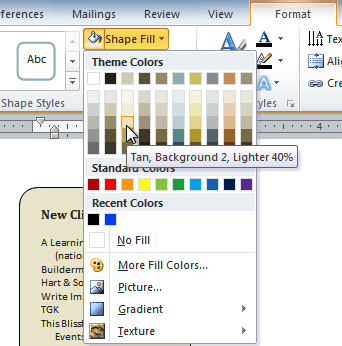 Changing the fill color
- Click the Shape Fill command to display a drop-down menu.
- From the drop-down menu, you can select a color from the list, choose No Fill , or select More Fill Colors to use a color that's not on the list.
To change the shape outline:
- Select the text box. The Format tab appears.
-
Click the
Shape Outline
command to display a drop-down list.
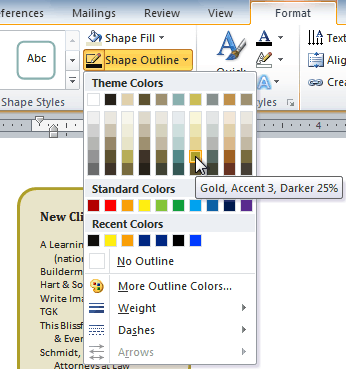 Changing the outline color
- Select a color from the list, choose No Outline , or select More Outline Colors to use a color that's not on the list.
- From the drop-down menu, you can change the outline color , weight (thickness), and whether it is a dashed line.
To change shadow effects:
- Select the text box. The Format tab appears.
- Select the Format tab.
- Click the Shape Effects command.
- Click Shadow .
-
Move your mouse over the menu options to see a live preview in your document.
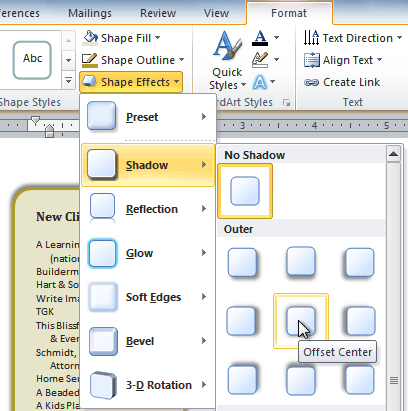 Adding a shadow
- Click the desired option to select the shadow effect.
To choose a different shadow color for your shape, select Shadow Options from the drop-down menu, then click the Color button.
3D effects
Just like other types of shapes, text boxes can have 3D effects . There are two types of effects you can apply to your shapes to give them a 3D appearance: 3-D Rotation and Bevel . 3-D Rotation gives the appearance that you are viewing an object from a different angle, and it can be applied to any shape. Bevel adds thickness and a rounded edge to shapes; however, it doesn't work with every type of shape.
To use 3-D Rotation:
- Select the text box.
- Select the Format tab.
- Click Shape Effects from the Shape Styles group.
-
Hover your mouse over
3-D Rotation
. A drop-down menu will appear.
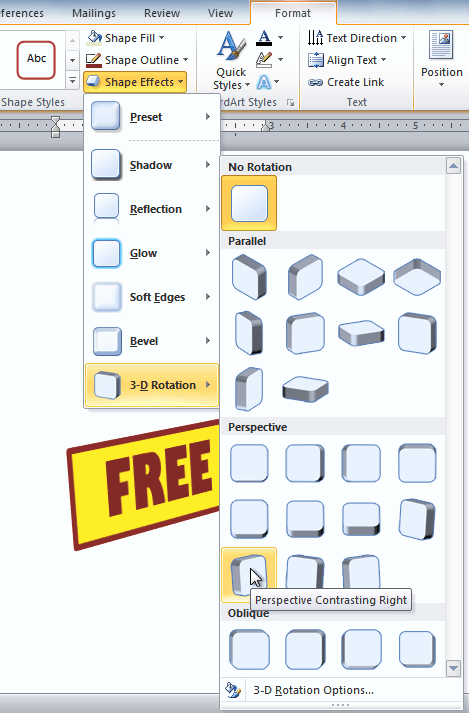 Applying 3-D Rotation to a text box
-
Select the desired
rotation preset
from the drop-down menu. You can also click
3-D Rotation Options
if you would prefer to type custom values.
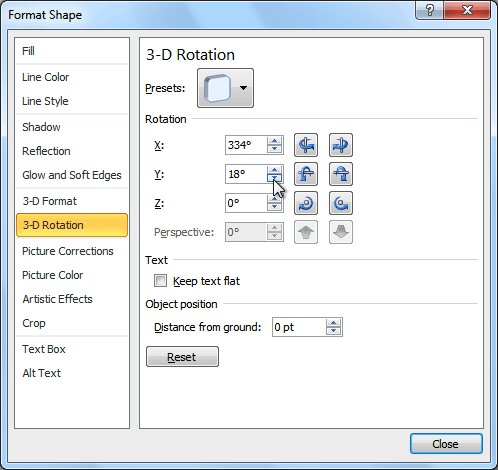 3-D Rotation Options
To use bevel:
- Select the text box.
- Select the Format tab.
- Click Shape Effects from the Shape Styles group.
-
Hover your mouse over
Bevel
. A drop-down menu will appear.
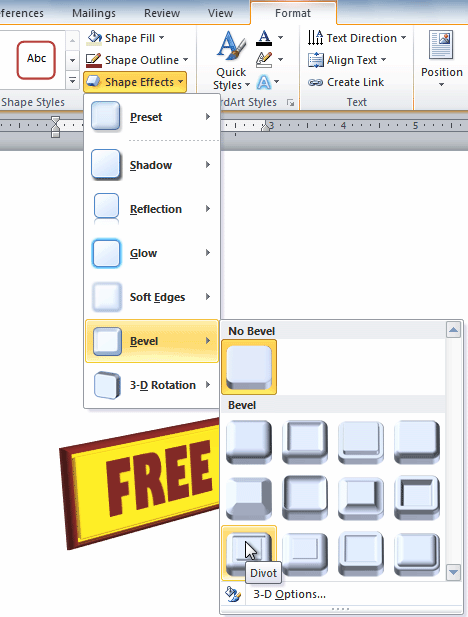 Adding bevel to a text box
- Select the desired bevel preset from the drop-down menu. You can also click 3-D Options if you would prefer to type custom values.
If you click 3-D Options , you'll also be able to change the shape's Material to give it a metal, plastic, or translucent appearance, and you can choose the Lighting type to change how the shape is illuminated.
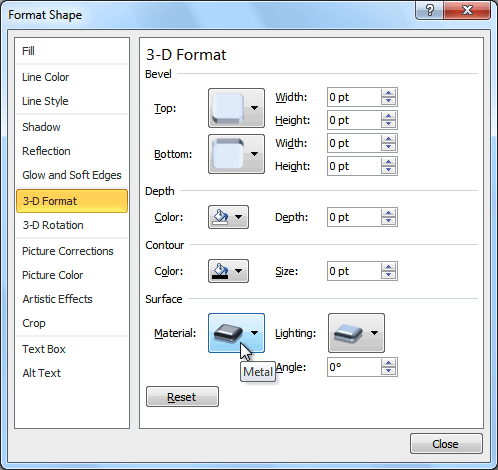 3-D Format Options
Creating WordArt
In addition to adding effects to a text box, you can add effects to the text inside the text box , which is known as WordArt . For the most part, the types of effects you can add are the same as the ones you can add to shapes or text boxes (shadow, bevel, etc.). However, you can also Transform the text to give it a wavy, slanted, or inflated look.
To apply a quick style to text:
A quick style will automatically apply several effects to your text at once. You can then refine the look of your text by adding or modifying text effects.
- Select the text box, or select some text inside of the text box. The Format tab will appear.
- Click the Format tab.
-
Click the
Quick Styles
command in the
WordArt Styles
group. A drop-down menu will appear.
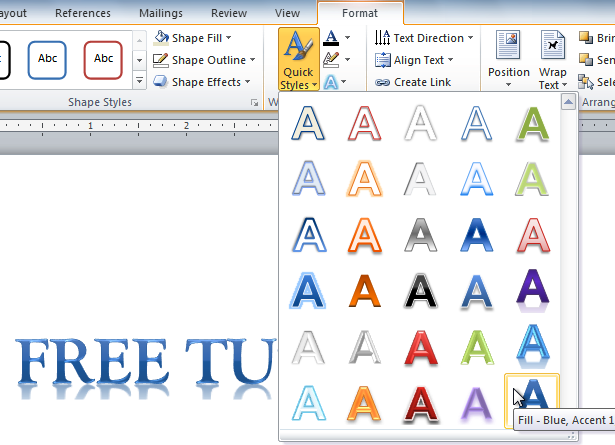 Selecting a Quick Style
- Select the desired style preset to apply the style to your text.
After you have applied a quick style, you can still modify the font or font color from the Home tab if you want.
To convert regular text into WordArt:
For text to be formatted as WordArt, it needs to be inside of a text box . However, there's a shortcut that allows you to convert text into WordArt even if it's not in a text box.
- Select the text you want to convert.
- Click the Insert tab.
-
Click the
WordArt
command. The
Quick Styles
drop-down menu will appear.
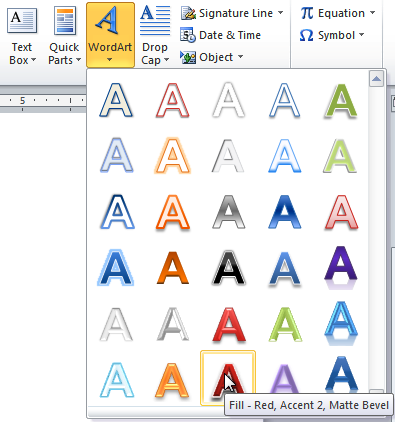 Converting text to WordArt
- Select the desired quick style .
-
Word will automatically create a text box for your text and apply the style to the text.
 After converting to WordArt
Some effects, such as shadows , can be added from the Text Effects menu in the Home tab. When you add effects in this way, it will not place the text in a text box.
To add or modify text effects:
- Select the text box, or select some text inside of the text box. The Format tab will appear.
- Click the Format tab.
-
Click the
Text Effects
command in the
WordArt Styles
group. A drop-down menu will appear, showing the different
effect categories
.
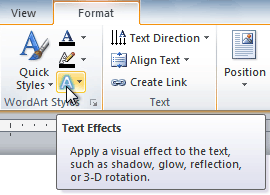 The Text Effects command
-
Hover over an effect category. A drop-down menu will appear. You can hover the mouse over the different presets to see a live preview.
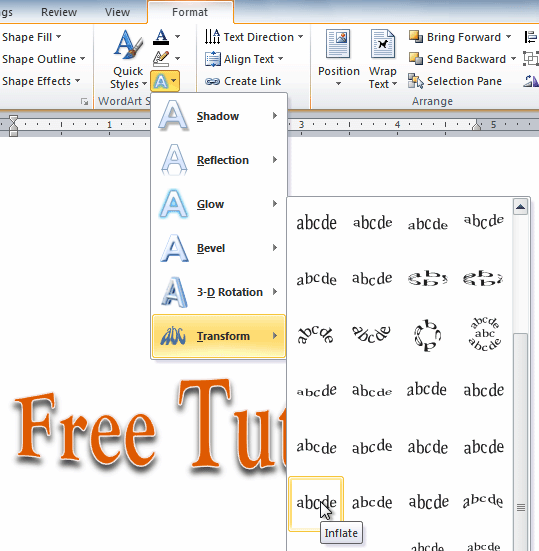 Adding an effect
-
Select the desired effect preset. The effect will be applied to your text. If you want, you can combine several effects.
 The finished WordArt
Challenge!
- Create a new document.
- Insert a text box .
- Enter some text into the text box.
- Move the text box to the desired location.
- Change the outline of the text box to a different color.
- Change the fill color of the text box.
- Add some WordArt effects to the text.