PowerPoint 2013
Shapes and WordArt

Introduction
There are many features and commands you can use in PowerPoint to create visually appealing slides. Two of these features are WordArt and shapes . WordArt allows you to create stylized text with effects such as textures, shadows, and outlines. You can also insert and modify a variety of shapes like rectangles, circles, lines, arrows, callouts, and stars.
Optional: Download our practice presentation .
About WordArt
PowerPoint allows you to add effects to the text inside of a text box , which is known as WordArt . For the most part, the types of effects you can add are the same as the ones you can add to shapes and text boxes (shadow, bevel, etc.). However, with WordArt, you can also Transform the text to give it a wavy, slanted, or inflated look.
To apply a WordArt style to text:
A WordArt Style will automatically apply several effects to your text at once. You can then refine the look of your text by adding or modifying text effects.
- Select a text box, or select some text inside of the text box.
-
On the
Format
tab, click the
More
drop-down arrow in the
WordArt Styles
group.
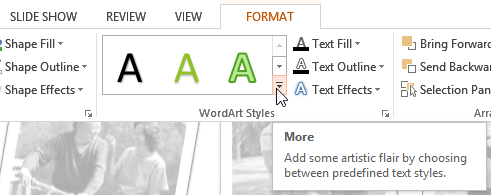 Clicking the More drop-down arrow
-
A drop-down menu of WordArt Styles will appear. Select the
style
you want to use.
 Selecting a WordArt Style
- The text will appear in the selected style. If desired, you can change the font or font color from the Home tab.
To add or modify text effects:
- Select a text box, or select some text inside of the text box. The Format tab will appear.
-
On the
Format
tab, click the
Text Effects
command in the
WordArt Styles
group.
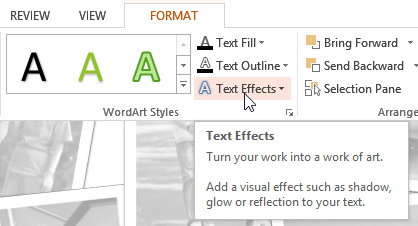 Clicking the Text Effects command
-
A drop-down menu will appear showing the different effect categories. Hover the mouse over an effect category, then select the desired
effect
from the menu that appears.
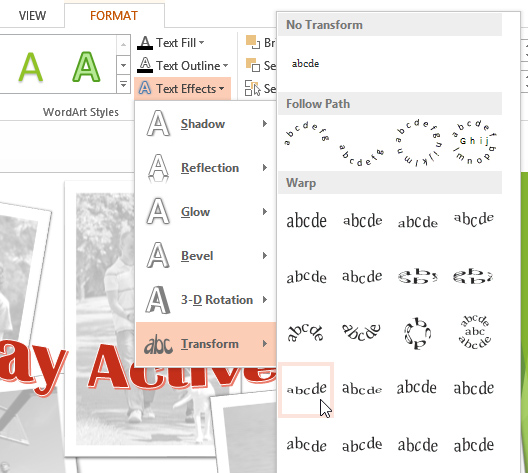 Adding an effect
-
The effect will be applied to your text. If you want, you can combine several different effects.
 The finished WordArt
In the WordArt Styles group, you can also use the Text Fill and Text Outline drop-down boxes to modify the fill and outline color.
 Changing the text fill color
Working with shapes and text boxes
PowerPoint's large shape collection allows you to organize and design the image you want. While you may not need shapes in every presentation you create, they can add visual appeal.
To insert a shape:
- Select the Insert tab, then click the Shapes command in the Illustrations group. A drop-down menu of shapes will appear.
-
Select the desired
shape
.
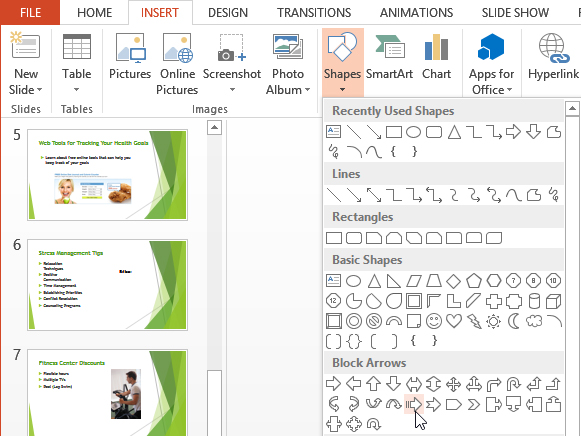 Selecting a shape
-
Click, hold, and drag in the desired location to add the shape to the slide.
 Inserting a new shape
If desired, you can enter text in a shape. When the shape appears in your document, you can simply begin typing. You can then use the formatting options on the Home tab to change the font, font size, or color of the text.
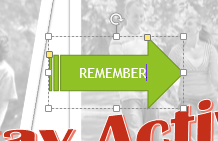 Entering text in a shape
Modifying a shape or text box
When you click a shape or text box, handles will appear that let you manipulate the shape. There are several types of handles:
-
Sizing handles:
Click, hold, and drag the
sizing handles
until the shape or text box is the desired size. You can use the corner sizing handles to change the
height
and
width
at the same time.
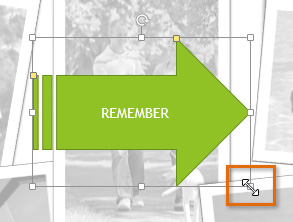 Resizing the shape
-
Yellow handles:
Some shapes have one or more
yellow handles
that can be used to customize the shape. For example, with arrow shapes you can adjust the width of the line and arrow tip.
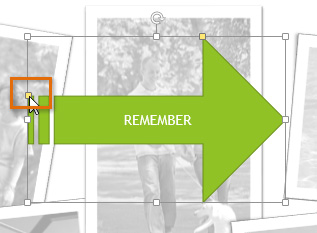 Modifying the shape
-
Rotation handle:
Click, hold, and drag the
rotation
handle to rotate the shape.
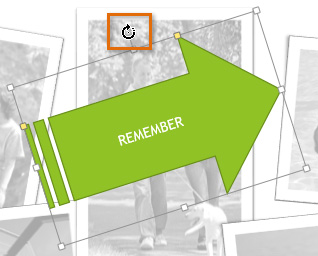 Rotating the shape
In addition to resizing, customizing, and rotating shapes, you can align, order, and group them. To learn more, visit our lesson on Arranging Objects .
Formatting shapes and text boxes
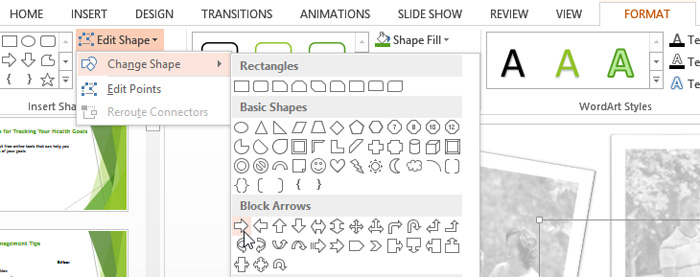
PowerPoint allows you to modify shapes and text boxes in a variety of ways so you can tailor them to your projects. You can change shapes and text boxes into different shapes , format their style and color , and add shadow effects .
To change to a different shape:
- Select the shape or text box you want to change. The Format tab will appear.
-
On the
Format
tab, click the
Edit Shape
command. In the menu that appears, hover the mouse over
Change Shape
and select the desired
shape
.
 Changing a shape
-
The new shape will appear.
 The new shape
To change the shape style:
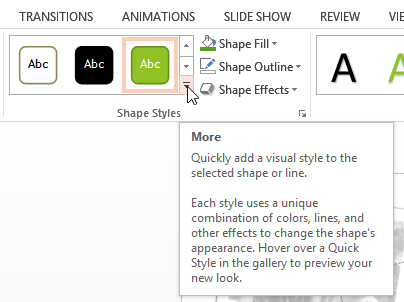
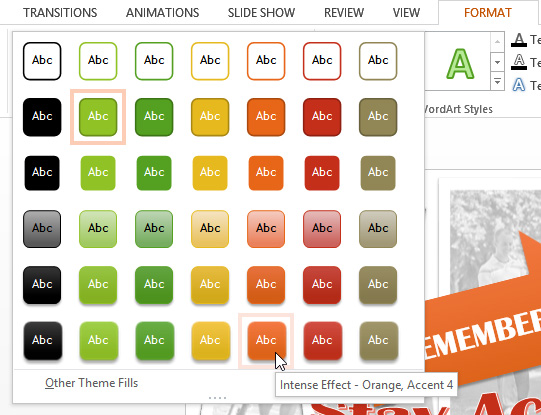
Choosing a Shape Style allows you to apply preset colors and effects to quickly change the appearance of your shape or text box.
- Select the shape or text box you want to change.
-
On the
Format
tab, click the
More
drop-down arrow in the
Shape Styles
group.
 Clicking the More drop-down arrow
-
A drop-down menu of styles will appear. Select the
style
you want to use.
 Selecting a shape style
- The shape or text box will appear in the selected style.
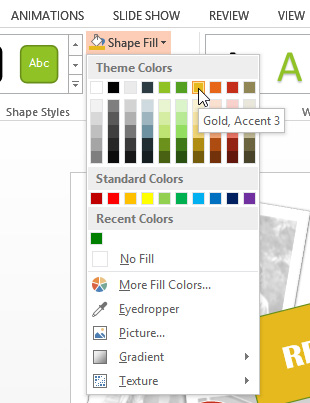
To change the shape fill color:
- Select the shape or text box you want to change.
- On the Format tab, click the Shape Fill drop-down arrow. The Shape Fill menu appears.
-
Move the mouse over the various colors. Select the
color
you want to use. To view more color options, select
More Fill Colors
.
 Changing the shape fill color
- The shape or text box will appear in the selected color.
If you want to use a different type of fill, select Gradient or Texture from the drop-down menu. You can also select No Fill to make it transparent.
To change the shape outline:
- Select the shape or text box you want to change.
- On the Format tab, click the Shape Outline drop-down arrow. The Shape Outline menu will appear.
-
Select the
color
you want to use. If you want to make the outline transparent, select
No Outline
.
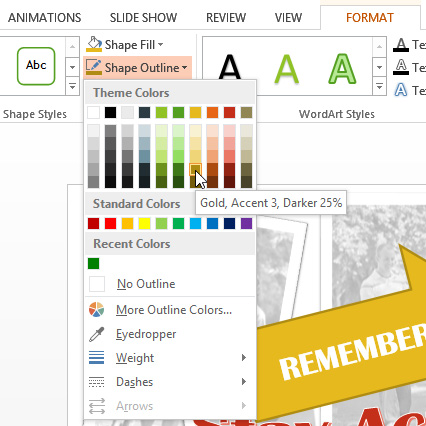 Changing the shape outline color
- The shape or text box will appear in the selected outline color.
From the drop-down menu, you can change the outline color , weight (thickness), and whether or not it is a dashed line.
 A thicker outline
To change shadow effects:
Adding a shadow to a shape can make it appear as though it is floating above the page, and it can help to add contrast between the shape and the background.
- Select the shape or text box you want to change.
-
On the
Format
tab, click the
Shape Effects
drop-down arrow. In the menu that appears, hover the mouse over
Shadow
and select the shadow you want to use.
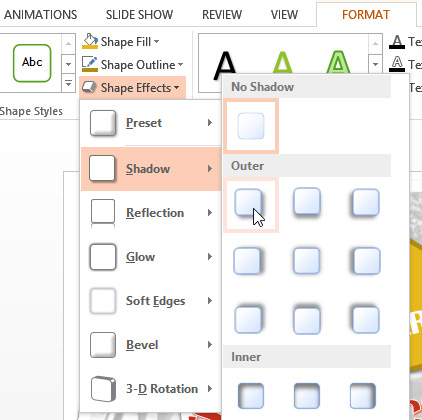 Choosing a shadow type
- The shape will appear with the selected shadow.
To adjust the shadow color, size, and distance, select Shadow Options from the drop-down menu. The Format Shape pane will appear on the right side of the PowerPoint window, allowing you to customize the shadow.
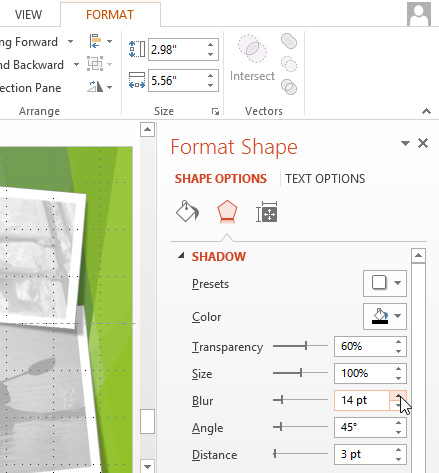 The Format Shape pane
3D effects
There are two types of effects you can apply to your shapes and text boxes to give them a 3D appearance: Bevel and 3-D Rotation . Bevel adds thickness and a rounded edge to shapes, but it doesn't work with every type of shape. 3-D Rotation gives the appearance that you are viewing the object from a different angle, and it can be applied to any shape.
To add a bevel:
- Select the shape or text box you want to change.
-
On the
Format
tab, click the
Shape Effects
drop-down arrow. In the menu that appears, hover the mouse over
Bevel
and select the desired
bevel preset
.
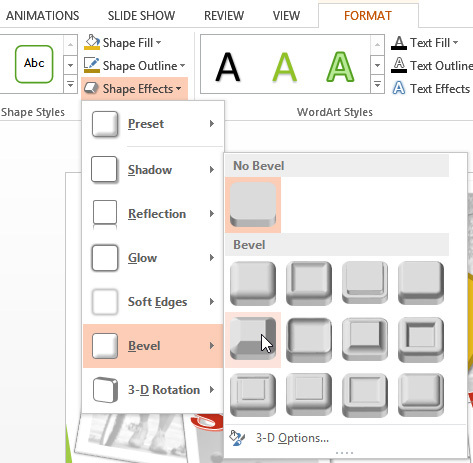 Choosing a bevel preset
-
The shape will appear in the selected bevel effect.
 The beveled shape
If you want, you can customize the bevel effect. Select 3-D Options from the drop-down menu. The Format Shape pane will appear on the right side of the PowerPoint window. From here, you can modify the width, height, and depth of a bevel. You can also change the shape's material to give it a metal, plastic, or translucent appearance, as well as choose the lighting type to change how the shape is illuminated.
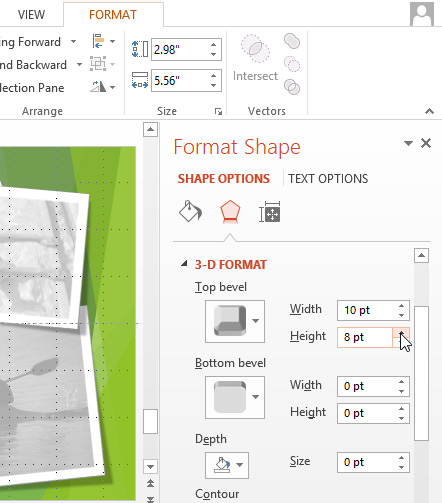 Customizing the bevel
To add 3-D Rotation:
- Select the shape or text box you want to change.
-
On the
Format
tab, click the
Shape Effects
drop-down arrow. In the menu that appears, hover the mouse over
3-D Rotation
and select the desired
3D effect
.
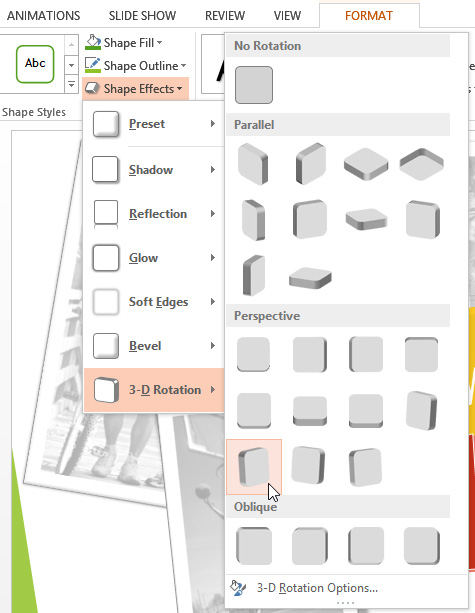 Choosing a 3-D rotation effect
- The shape will appear in the selected 3D rotation effect.
If you want, you can customize 3-D Rotation. Select 3-D Rotation Options from the drop-down menu, and the Format Shape pane will appear on the right side of the PowerPoint window. From here, you can adjust the rotation values.
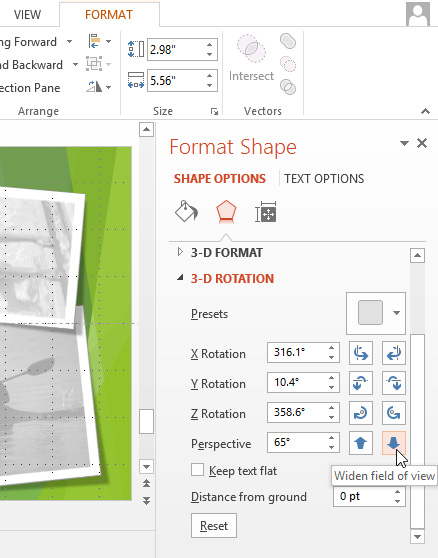 Customizing the 3-D rotation
Challenge!
- Open an existing PowerPoint presentation . If you want, you can download our practice presentation .
- Add some WordArt effects to the text. If you are using the example, use the text on slide 6.
- Insert a shape .
- Change the shape to a different shape .
- Change the fill color .
- Change the outline color .
- Try various shadow effects .
- Try various 3D effects .