PowerPoint 2013
Hyperlinks and Action Buttons

Introduction
Whenever you use the Internet, you use hyperlinks to navigate from one webpage to another. If you want to include a web address or email address in your PowerPoint presentation, you can choose to format it as a hyperlink so a person can easily click it. It's also possible to link to files and other slides within a presentation. It's easy to do all of this using two tools: hyperlinks and action buttons
Optional: Download our practice presentation .
About hyperlinks
Hyperlinks have two basic parts : the address of the webpage, email address, or other location they are linking to, and the display text (which can also be a picture or shape). For example, the address could be https://www.youtube.com , and YouTube could be the display text. In some cases, the display text might be the same as the address. When you're creating a hyperlink in PowerPoint, you'll be able to choose both the address and the display text or image.
To insert a hyperlink:
- Select the image or text you want to make a hyperlink.
-
Right-click the selected text or image, then click
Hyperlink
.
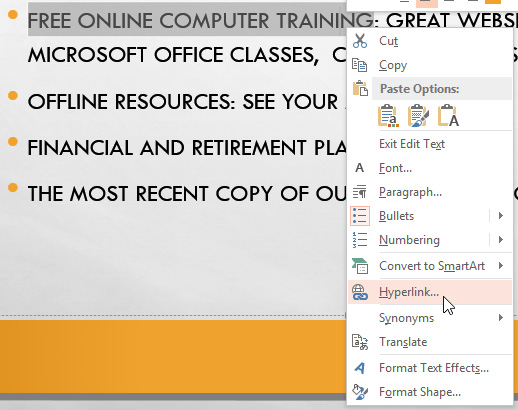 Creating a hyperlink
-
The
Insert Hyperlink
dialog box will open. You can also get to this dialog box from the
Insert
tab by clicking
Hyperlink
.
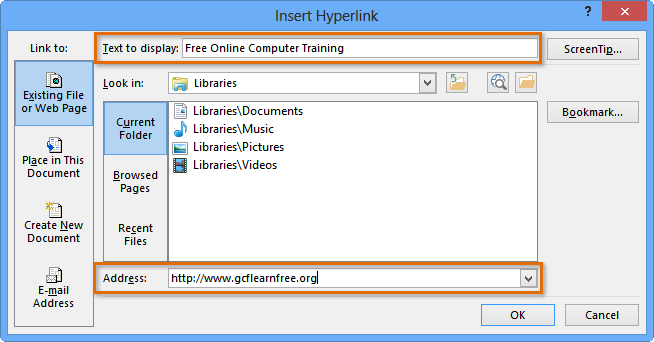 The Insert Hyperlink dialog box
- If you selected text, the words will appear in the Text to display field at the top. You can change this text if you want.
- Type the address you want to link to in the Address field.
-
Click
OK
. The text or image you selected will now be a hyperlink to the web address.
 The completed hyperlink
To insert a hyperlink to an email address:
- Right-click the selected text or image, then click Hyperlink .
- The Insert Hyperlink dialog box will open.
-
On the left side of the dialog box, click
Email Address
.
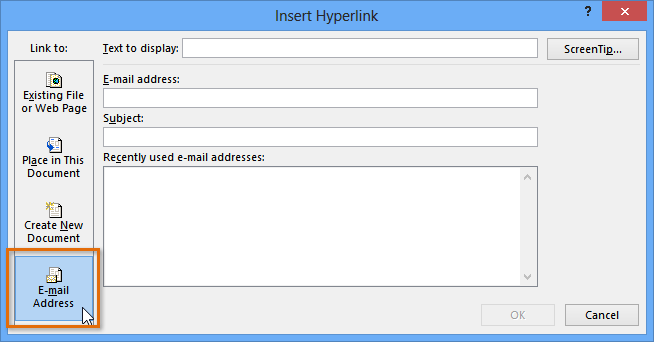 Creating an email hyperlink
-
Type the email address you want to connect to in the
Email Address
box, then click
OK
.
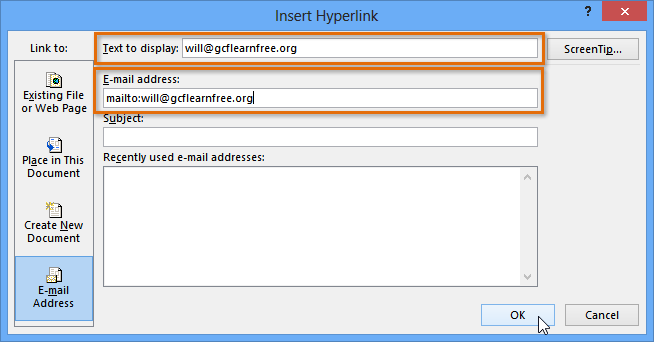 Typing the email address and display text
PowerPoint often recognizes email and web addresses as you type and will format them as hyperlinks automatically after you press the Enter key or spacebar .
To open and test a hyperlink
-
After you create a hyperlink, you should
test
it. Right-click the hyperlink, then click
Open Hyperlink
.
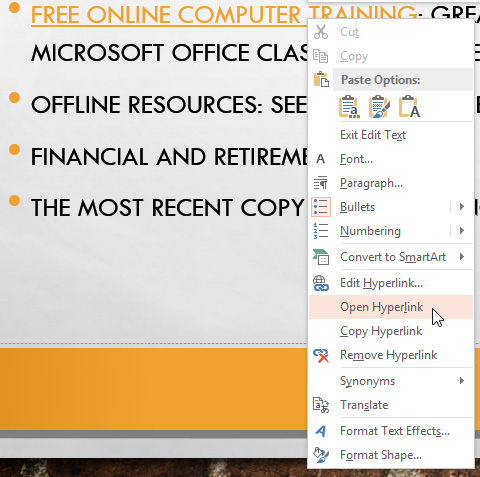 Opening a hyperlink
- Your web browser should open and then navigate to the linked page. If it does not work, check the hyperlink address for any misspellings.
To open a hyperlink while viewing your slide show, click the hyperlink.
 Clicking a hyperlink
To remove a hyperlink:
- Right-click the hyperlink.
-
Click
Remove Hyperlink
.
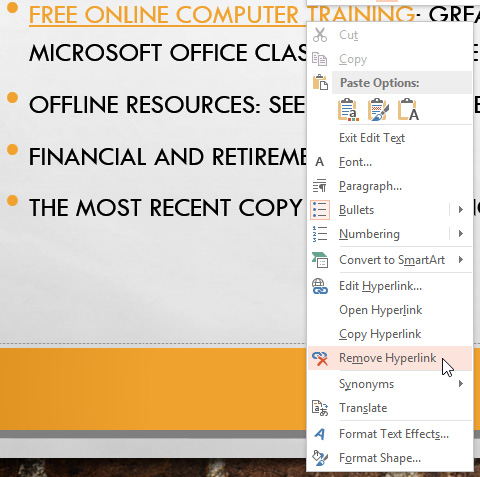 Removing a hyperlink
More hyperlinks
In PowerPoint, you can use hyperlinks to link to resources that are not online. To create a quick way to refer to another slide in your presentation, you can create a hyperlink to that slide. If you need to access a file stored on your computer, you can create a hyperlink to it. Additionally, PowerPoint allows you to format pictures and shapes as hyperlinks.
To insert a hyperlink to another slide:
- Right-click the selected text or image, then click Hyperlink .
- The Insert Hyperlink dialog box will appear.
-
On the left side of the dialog box, click
Place in this Document
.
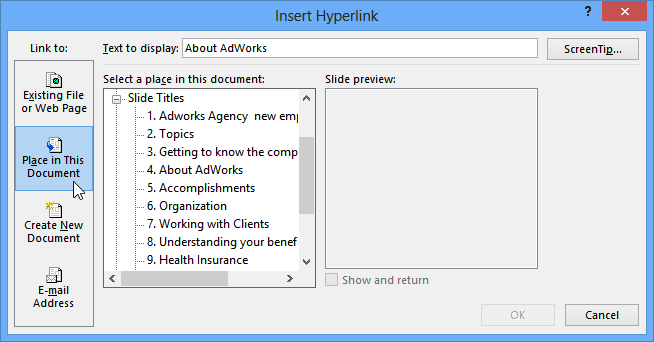 Creating a hyperlink to another slide
-
A list of the other slides in your presentation will appear. Click the name of the slide you want to link to.
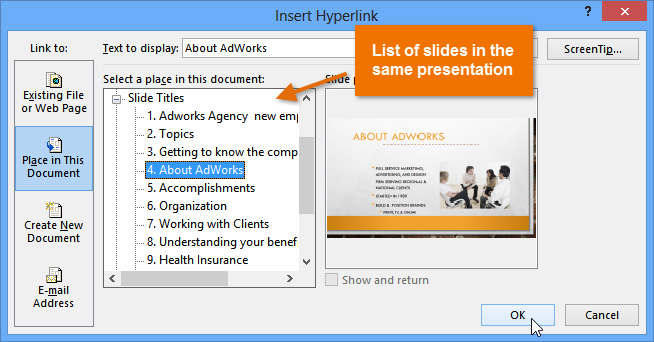 Selecting a slide
-
Click
OK
. The text or image will now be a hyperlink to the slide you selected.
 The completed hyperlink to a slide
To insert a hyperlink to another file:
- Right-click the selected text or image, then click Hyperlink . The Insert Hyperlink dialog box will appear.
- On the left side of the dialog box, click Existing File or Webpage .
-
Click the drop-down arrow to browse for your file.
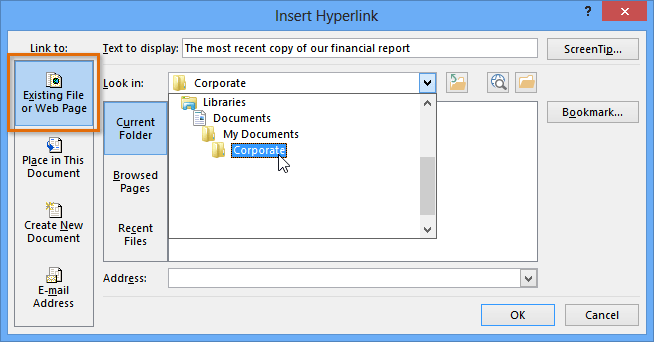 Creating a hyperlink to a file
-
Select the desired file.
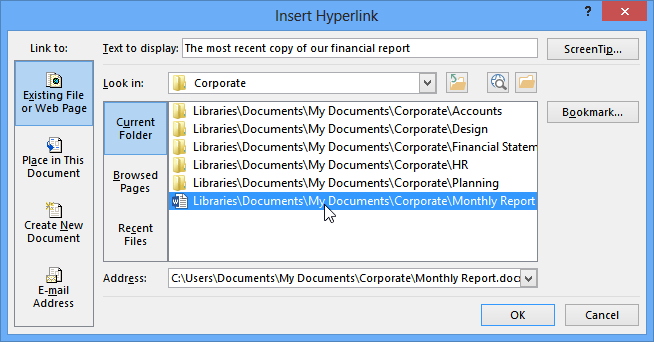 Selecting a file
-
Click
OK
. The text or image will now be a hyperlink to the file you selected.
 The completed hyperlink to a file
If you plan on displaying your presentation on a different computer than you used to create it, your hyperlink to another file may not work. Make sure you have a copy of the linked file on the computer you are using to present, and always test hyperlinks before giving a presentation.
Using shapes and pictures as hyperlinks
Sometimes you might want to to format objects —including shapes, text boxes, and pictures—as hyperlinks. This is especially helpful if you want the object to act like a button . To do this, right-click the desired object and select Hyperlink from the menu that appears. Click the object during the presentation to open the hyperlink.
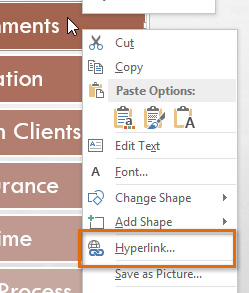 Hyperlinking an object
Inserting action buttons
Another tool you can use to connect to a webpage, file, email address, or slide is called an action button . Action buttons are built-in button shapes you can add to a presentation and set to link to another slide, play a sound, or perform a similar action. When someone clicks or moves over the button, the selected action will occur. Action buttons can do many of the same things as hyperlinks. Their easy-to-understand style makes them especially useful for self-running presentations at booths and kiosks.
You can insert action buttons on one slide at a time, or you can insert an action button that will show up on every slide. The second option can be useful if you want every slide to link back to a specific slide, like the title page or table of contents.
To insert an action button on one slide:
- Click the Insert tab.
-
Click the
Shapes
command in the Illustrations group. A drop-down menu will appear with the
action buttons
located at the very bottom.
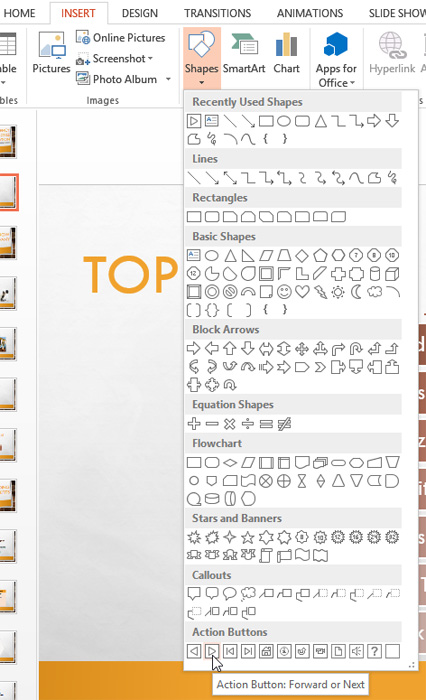 Selecting an action button
- Select the desired action button .
- Insert the button onto the slide by clicking the desired location. The Action Settings dialog box will appear.
-
Select the
Mouse Click
or
Mouse Over
tab. Selecting the
Mouse Click
tab means the action button will perform its action only when clicked. Selecting the
Mouse Over
tab will make the action button perform its action when you move the mouse over it.
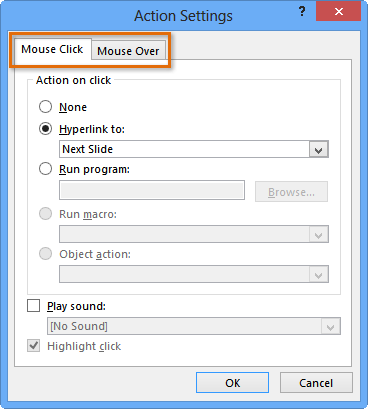 The Action Settings dialog box
-
In the
Action on click
section, select
Hyperlink to:
then click the drop-down arrow and choose an option from the menu.
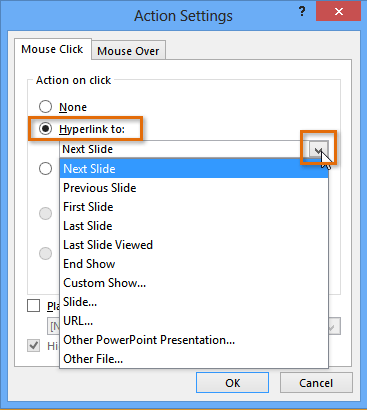 Creating a hyperlink with an action button
-
Check the
Play Sound
box if you want a sound to play when the action button is clicked. Select a sound from the drop-down menu, or select
Other sound
to use a sound file on your computer.
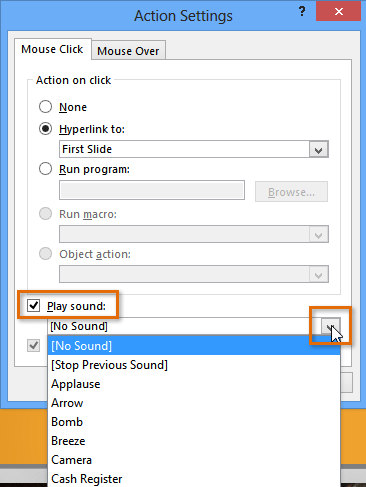 Selecting a sound
-
Click
OK
.
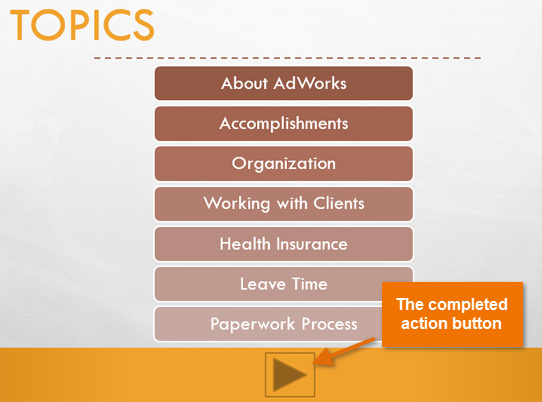 The completed action button
To insert an action button on all slides:
- Click the View tab.
-
In the
Master Views
group, click the
Slide Master
command. A blank slide in the style of your presentation will appear. Don't worry about changing anything else.
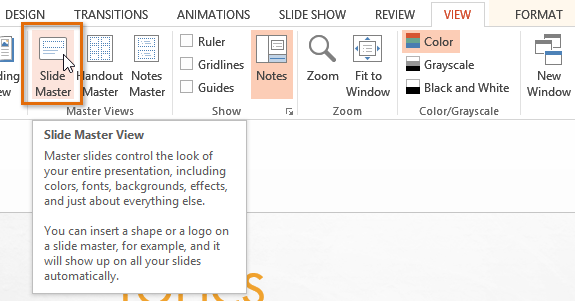 Changing the view to Slide Master
- Go to the Insert tab, and follow the instructions above to insert an action button .
-
Return to the
Slide Master
tab, and click
Close Master View
. The new action button will now be on every slide.
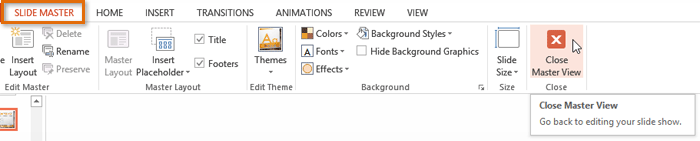 Returning to the normal view
To edit, move, or delete an action button inserted this way, click the View tab, then Slide Master . Click Close Master View after making the desired changes.
To test an action button:
After you create an action button, you should test it.
- Click the Slide Show tab.
-
In the
Start Slide Show
group, click
From Current Slide
.
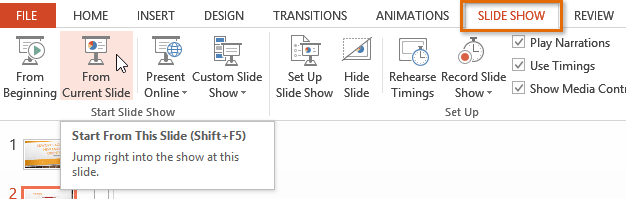 Viewing the slide show
- Click your action button.
-
After you have tested it, right-click anywhere on the screen and select
End Show
.
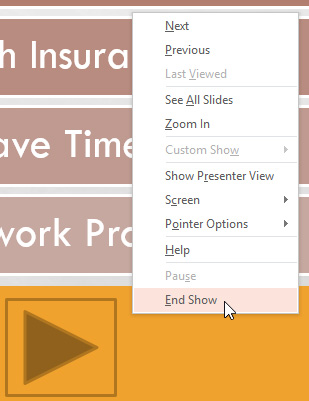 Ending the slide show
- If your action button did not work as you intended, follow the instructions below to edit it.
To edit an action button:
- Select the action button.
- Click the Insert tab.
-
In the
Links
group, click the
Action
command. The
Actions Settings
dialog box will appear.
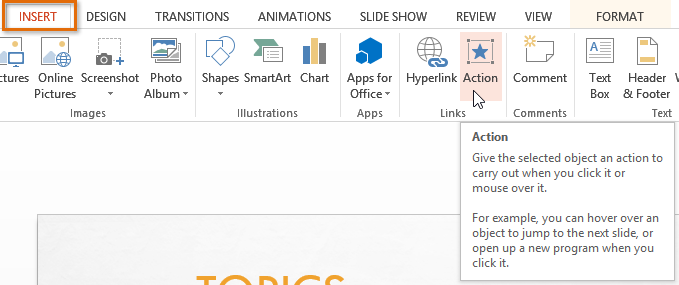 Editing an action button
- Edit the action or hyperlink.
- Click OK .
To change the appearance of an action button:
- Select the action button .
-
Click the
Format
tab.
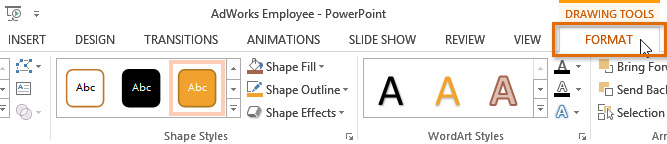 Changing the appearance of an action button
-
To change the button
style
or
color
, use the tools in the
Shape Styles
group.
 Changing the style of an action button
-
To change the
shape
of the action button, click
Edit Shape
in the
Insert Shapes
group. Select a new shape from the drop-down menu.
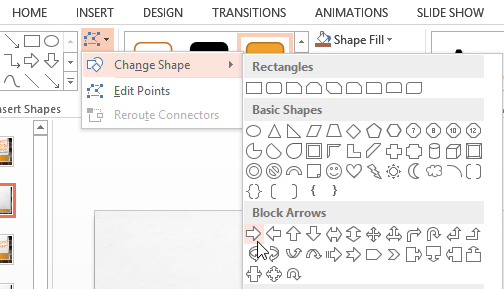 Changing the shape of the action button
Challenge!
- Open an existing PowerPoint presentation . If you want, you can download our practice presentation .
- Select text, and insert a hyperlink to a webpage . If you are using the example, go to slide 12. Turn the words Financial and Retirement Planning into a hyperlink to http://www.mutualofamerica.com/.
- Select text or an image, and insert a hyperlink to another slide in the presentation. If you are using the example, go to slide 2 and make the words Paperwork Process link to slide 11.
- Insert an action button that uses sound. If you are using the example, go to slide 12 and create an action button that links back to slide 1.
- Change the shape and style of an action button. If you are using the example, modify the shape and style of the action button you inserted on slide 12.