PowerPoint 2010
Arranging Objects

Introduction
In PowerPoint, each slide may have multiple items, such as pictures, shapes, and text boxes. PowerPoint lets you arrange the objects the way you want by
aligning
,
grouping
,
rotating
, and
ordering
them in various ways.
In this lesson, you will learn how to
align
objects across the slide,
group
multiple objects into one object, and
order
objects from front to back.
Arranging objects
After adding objects to a slide, it may be necessary to arrange them so the objects appear the way you want. You can align , group , rotate , and order objects to create the desired arrangement.
Optional: You can download this example for extra practice.
Aligning objects
You can click and drag objects to align them manually, but guesswork will never give you the best result. Additionally, aligning objects in this way can take a great deal of time. Luckily, PowerPoint provides you with several commands that allow you to easily arrange and position objects.
To align two or more objects:
-
Click and drag your mouse to form a
selection box
around the objects you want to align. All of the objects will now have
sizing handles
to show that they are selected.
 Selecting multiple objects
-
From the
Format
tab, click the
Align
command, and select
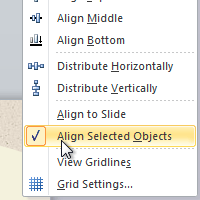
Align Selected Objects
.
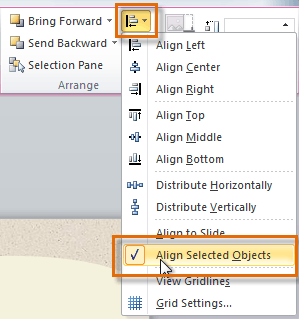 Choosing Align Selected Objects
-
Click the
Align
command again, and select one of the six
alignment options
.
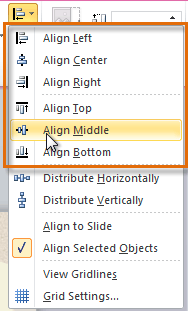 Choosing an alignment option
-
The objects will align to each other based on the option you have selected.
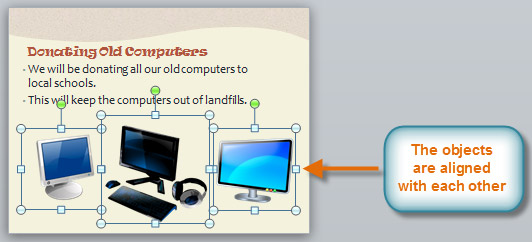 The aligned objects
To align objects to the slide:
Sometimes you may want to align one or more objects to a specific location within the slide , such as the top or bottom. You can do this by selecting the Align to Slide option before you align the objects.
- Click and drag your mouse to form a selection box around the objects you want to align. All of the objects will now have sizing handles to show that they are selected.
-
From the
Format
tab, click the
Align
command, and select
Align to Slide
.
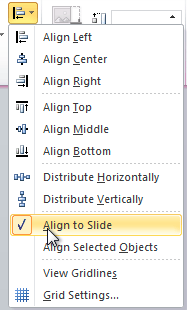 Selecting Align to Slide
-
Click the
Align
command again, and select one of the six
alignment options
.
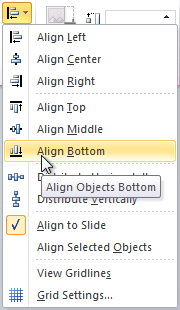 Aligning objects to the bottom of the slide
-
The objects will align to the slide based on the option you have selected.
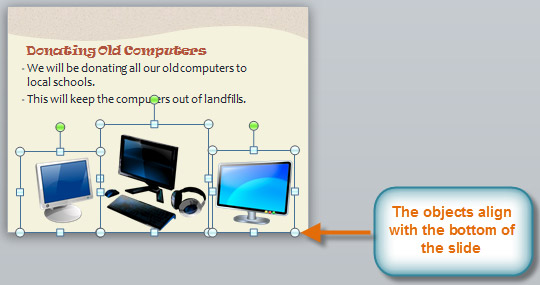 The aligned objects
To distribute objects evenly:
If you have arranged objects in a row or column, you may want them to be an equal distance from one another for a neater appearance. You can do this by distributing the objects horizontally or vertically.
-
Click and drag your mouse to form a
selection box
around the objects you want to align. All of the objects will now have
sizing handles
to show that they are selected.
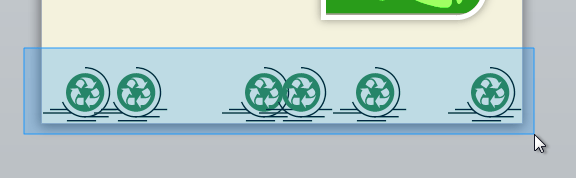 Selecting multiple objects
- From the Format tab, click the Align command.
-
From the menu, select
Distribute Horizontally
or
Distribute Vertically
.
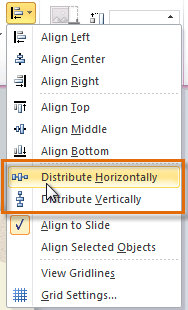 Choosing a distribute option
-
The objects will be distributed evenly.
 Objects distributed evenly
Ordering and rotating objects
In addition to aligning and grouping objects, PowerPoint gives you the ability to arrange objects in a specific order . Ordering is important when two or more objects overlap because it will determine which objects are in the front or back .
To change the ordering by one level:
-
Select an object. The Format tab will appear.
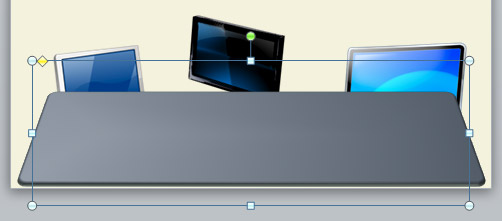 The selected object
-
From the
Format
tab, click the
Bring Forward
or
Send Backward
command to change the object's ordering by
one level
. If the object overlaps with more than one other object, you may need to click the command
several times
to achieve the desired ordering.
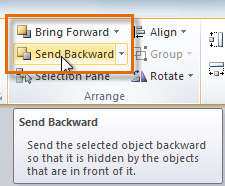 Sending an object backward
-
The objects will reorder.
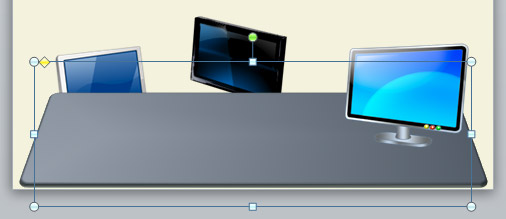 The reordered objects
To bring an object to the front or back:
If you want to move an object behind or in front of several objects, it's usually faster to bring it to front or send it to back rather than clicking the ordering commands multiple times.
- Select an object. The Format tab will appear.
- From the Format tab, click the Bring Forward or Send Backward drop-down box.
-
From the drop-down menu, select
Bring to Front
or
Send to Back
.
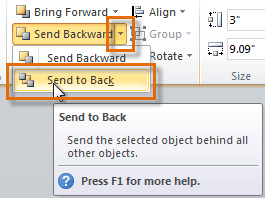 Sending an object to the back
-
The objects will reorder.
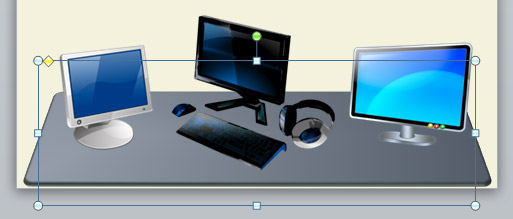 The reordered objects
To rotate an object:
- Select an object. The Format tab will appear.
- From the Format tab, click the Rotate command. A drop-down menu will appear.
-
Select the desired
rotation option
.
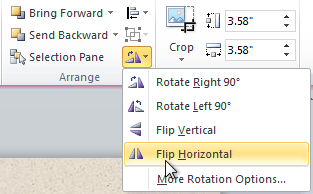 Selecting a rotation option
-
The object in the slide will rotate.
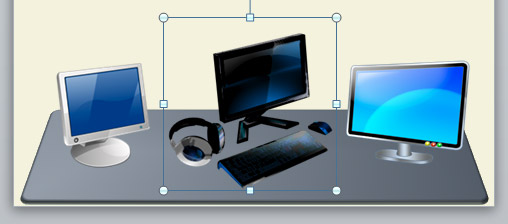 The rotated image
Grouping objects
Sometimes you may want to group multiple objects into one object so they will stay together if they are moved. Often, this is easier than selecting all of the objects every time you want to move them.
Pictures, shapes, clip art, and text boxes can all be grouped together, but placeholders cannot be grouped. Therefore, make sure not to insert your pictures into placeholders if you will be grouping the pictures.
To group objects:
-
Click and drag your mouse to form a
selection box
around the objects you want to align. All of the objects will now have
sizing handles
to show that they are selected.
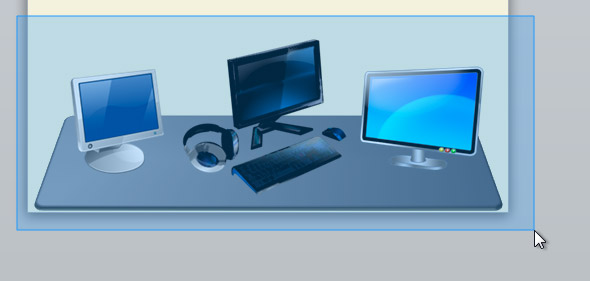 Selecting multiple objects
-
From the
Format
tab, click the
Group
command, then select
Group
.
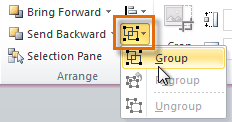 Grouping objects
-
The selected objects will now be grouped. There will be a
single box with sizing handles
around the entire group to show that they are one object.
 The grouped objects
If you select the objects and the Group command is disabled, it may be because one of the objects is inside a placeholder . If this happens, try reinserting the images or cutting and pasting them into the same slide outside of any placeholders.
To ungroup objects:
- Select the grouped object you want to ungroup.
-
From the
Format
tab, click the
Group
command, then select
Ungroup
.
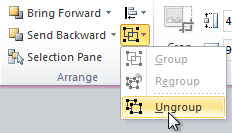 Ungrouping objects
-
The objects will be ungrouped.
 The ungrouped objects
Challenge!
- Open an existing PowerPoint presentation . If you want, you can use this example .
- Practice using the align options from the Align command. If you are using the example, align the images on slide 5.
- Practice using the rotate options.
- Create a new shape , then send it behind the other objects.
- Group the objects into one object.
- Move the grouped object to a new location on the slide.
- Ungroup the object.