PowerPoint 2010
Animating Text and Objects

Introduction
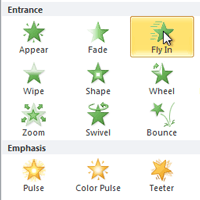
In PowerPoint you can
animate
text and objects such as clip art, shapes, and pictures. Animation—or movement—on the slide can be used to
draw
the
audience's attention
to specific content or to make the slide easier to read.
In this lesson, you will learn how to add
animation effects
to text and objects and
customize them
.
Animating text and objects
PowerPoint offers a variety of animations you can use to enhance your presentation. Animations can be used to make text or objects appear on a slide, exit a slide, or emphasize the text or objects already on a slide. You can even use motion paths to create a customized animation.
Optional: You can download this example for extra practice.
The four types of animations
There are many different animation effects you can choose from, and they are organized into four types:
-
Entrance:
These control how the object enters the slide. For example, with the
Bounce
animation, the object will drop onto the slide and then bounce several times.
 Entrance effects
-
Emphasis:
These animations occur while the object is on the slide and are often triggered by a
mouse click
. For example, you can set an object to
Spin
when you click the mouse.
 Emphasis effects
-
Exit:
These control how the object exits the slide. For example, with the
Fade
animation, the object will simply fade away.
 Exit effects
-
Motion Paths:
These are similar to
Emphasis
effects, except the object moves within the slide along a predetermined path, like a
circle
.
 Motion Paths
To apply an animation to an object:
- Select an object.
- Click the Animations tab.
-
In the
Animation
group, click the
More
drop-down arrow to view the available animations.
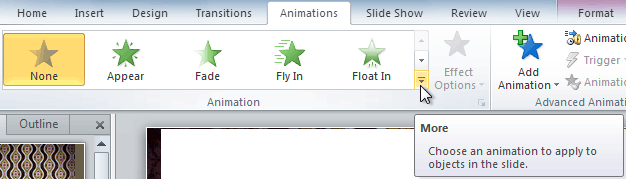 The More drop-down arrow
-
Select the desired animation effect.
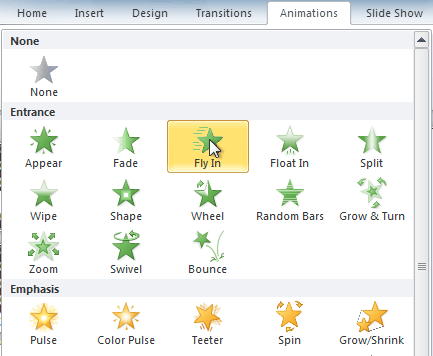 Selecting an effect
-
The object will now have a small
number
next to it to show that it has an animation. Also, in the Slide pane, the slide will now have a
star
symbol next to it.
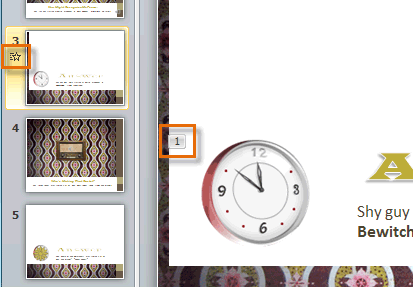 The number and the star indicate that an effect has been added
At the bottom of the menu, you can access even more effects.
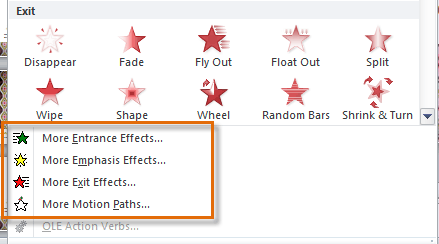 More animation effects
Effect options
Some effects will have options you can change. For example, with the Fly In effect, you can control which direction the object comes from. These options can be accessed from the Effect Options command in the Animation group.
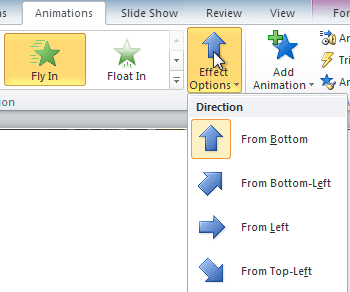 Viewing the options for the Fly In effect
Working with animations
To add multiple animations to an object:
If you select a new animation from the menu in the Animation group, it will replace the object's current animation . However, you'll sometimes want to place more than one animation on an object, such as with an entrance and exit effect. To do this, you'll need to use the Add Animation command, which will allow you to keep your current animations while adding new ones.
- Select the object.
- Click the Animations tab.
- In the Advanced Animation group, click the Add Animation command to view the available animations.
-
Select the desired animation effect.
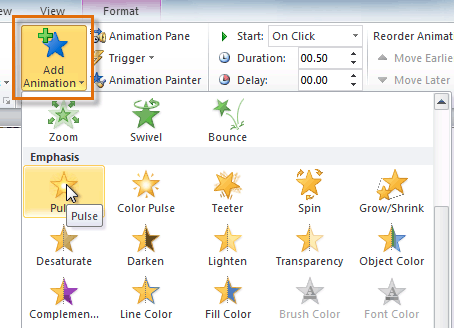 Adding an additional animation
-
If the object has more than one effect, it will have a different
number
for each effect. The numbers indicate the
order
in which the effects will occur.
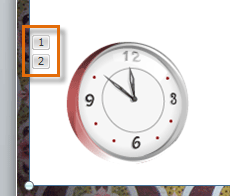 An object with two animations
It's important to consider how you want animations to appear in your slide show. Well-placed animations can help emphasize important points or information, while too many animations can become distracting for your audience.
To copy animations with the Animation Painter:
Sometimes you may want to apply the same effects to more than one object. You can do this by copying the effects from one object to another using the Animation Painter .
- Click the object that has the effects you want to copy.
-
From the
Animations
tab, click the
Animation Painter
command.
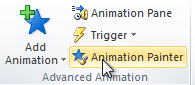 The Animation Painter command
-
Click the object you want to copy the effects to. The effects will be applied to the object.
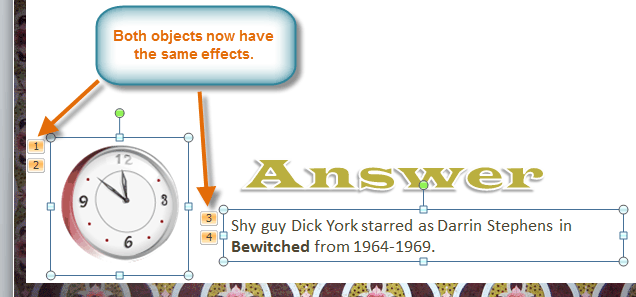 After copying the effects
To reorder the animations:
-
Select the
number
of the effect you want to change.
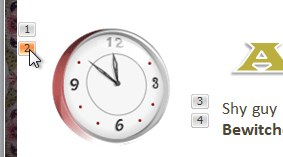 Selecting an effect
-
From the
Animations
tab, click the
Move Earlier
or
Move Later
commands to change the ordering.
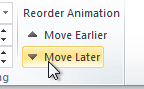 Moving the effect later
To preview animations:
Any animation effects you have applied will show up when you play the slide show. However, you can also quickly preview the animations for the current slide without viewing the slide show.
- Navigate to the slide you want to preview.
-
From the
Animations
tab, click the
Preview
command. The animations for the current slide will play.
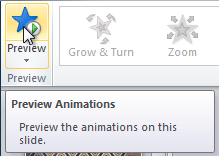 Previewing the animations
The Animation pane
The Animation pane allows you to view and manage all of the effects that are on the current slide. You can modify and reorder effects directly from the Animation pane, which is especially useful when you have several effects.
To open the Animation pane:
-
From the
Animations
tab, click the
Animation Pane
command.
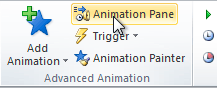 Opening the Animation Pane
-
The Animation pane will open on the right side of the window. It will show all of the effects for the current slide in the order they will appear.
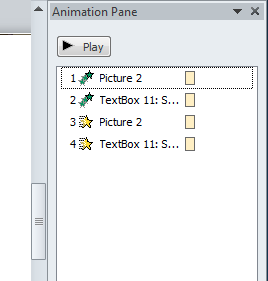 The Animation Pane
To reorder effects from the Animation pane:
-
On the
Animation pane
, click and drag an effect up or down.
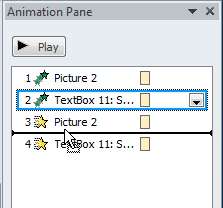 Dragging an effect to change the order
- The effects will reorder.
To preview effects from the Animation pane:
-
From the
Animation pane
, click the
Play
button.
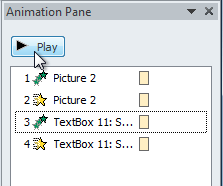 The Play button
-
The effects for the current slide will play. On the right side of the Animation pane, you will be able to see a
timeline
that shows the progress through each effect.
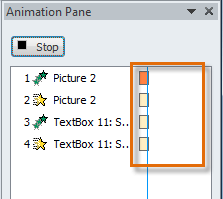 The timeline shows which effect is playing
If the timeline is not visible, click the drop-down arrow for an effect, then select Show Advanced Timeline .
To change an effect's start option:
By default, an effect begins playing when you click the mouse during a slide show. If you have multiple effects, you will need to click multiple times to start each effect individually. However, by changing the start option for each effect, you can have effects that automatically play at the same time or one after the other .
-
From the
Animation pane
, select an effect. A drop-down arrow will appear next to the effect.
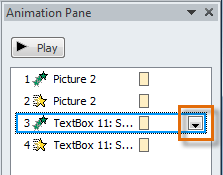 The drop-down arrow for an effect
-
Click the drop-down arrow. You will see three
start options
:
- Start on Click: This will start the effect when the mouse is clicked.
- Start With Previous: This will start the effect at the same time as the previous effect.
- Start After Previous: This will start the effect when the previous effect ends.
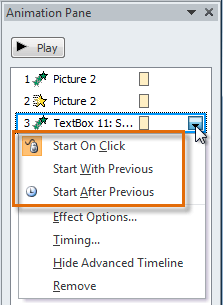 The three start options
- Select the desired start option.
When you preview the animations, all of the effects will play through automatically. To test effects that are set to Start on Click , you will need to play the slide show.
The Effect Options dialog box
From the Animation pane, you can access the Effect Options dialog box, which contains more advanced options you can use to fine tune your animations.
To open the Effect Options dialog box:
- From the Animation pane , select an effect. A drop-down arrow will appear next to the effect.
- Click the drop-down arrow, and select Effect Options . The Effect Options dialog box will appear.
-
From here, you can add various
enhancements
to the effect:
- Sound : This adds a sound effect to the animation.
- After animation : This changes the color or hides the object after the animation is over.
- Animate text : If you are animating text, you can choose to animate it all at once , one word at a time , or one letter at a time .
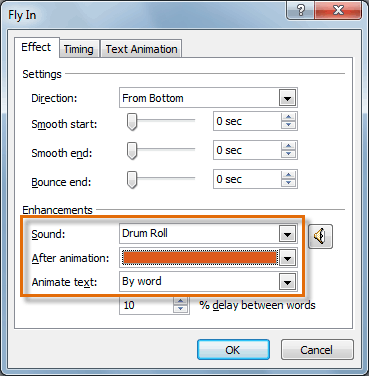 The Effect Options dialog box
Some effects have additional options you can change. These will vary depending on the effect you've selected.
To change the effect timing:
-
From the
Effect Options
dialog box, select the
Timing
tab.
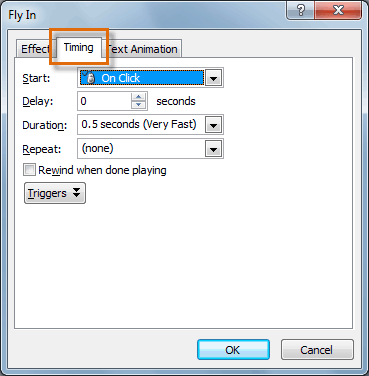 Selecting the Timing tab
-
From here, you can add a
delay
before the effect starts, change the
duration
of the effect, and control whether the effect
repeats
.
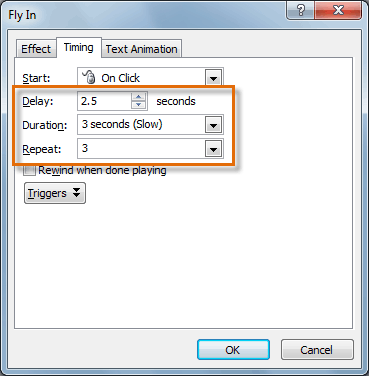 Changing the timing options
Challenge!
- Open an existing PowerPoint presentation . If you want, you can use this example .
- Add an entrance effect to an object. If you are using the example, use one of the objects on slide 3.
- Use the Animation Painter to copy the effect to another object.
- Use the Animation pane to reorder the effects.
- Experiment with different start options and timings .
- Add two additional effects to one of the objects.