Excel 2013
Sorting Data

Introduction
As you add more content to a worksheet, organizing this information becomes especially important. You can quickly reorganize a worksheet by sorting your data. For example, you could organize a list of contact information by last name. Content can be sorted alphabetically, numerically, and in many other ways
Optional: Download our practice workbook .
Types of sorting
When sorting data, it's important to first decide if you want the sort to apply to the entire worksheet or just a cell range .
-
Sort sheet
organizes all of the data in your worksheet by one column. Related information across each row is kept together when the sort is applied. In the example below, the
Contact Name
column (column
A
) has been sorted to display the names in alphabetical order.
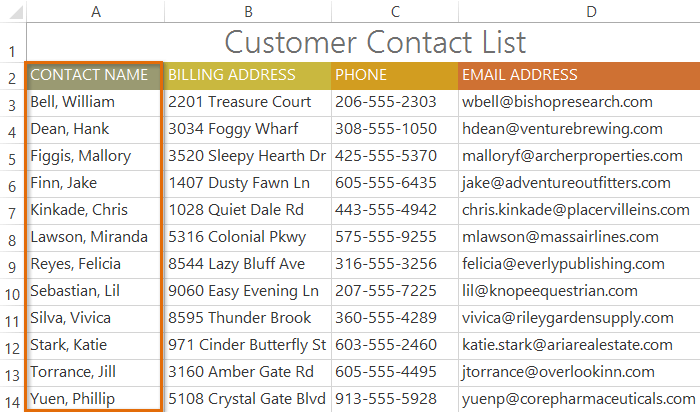 Sorting a sheet
-
Sort range
sorts the data in a range of cells, which can be helpful when working with a sheet that contains several tables. Sorting a range will not affect other content on the worksheet.
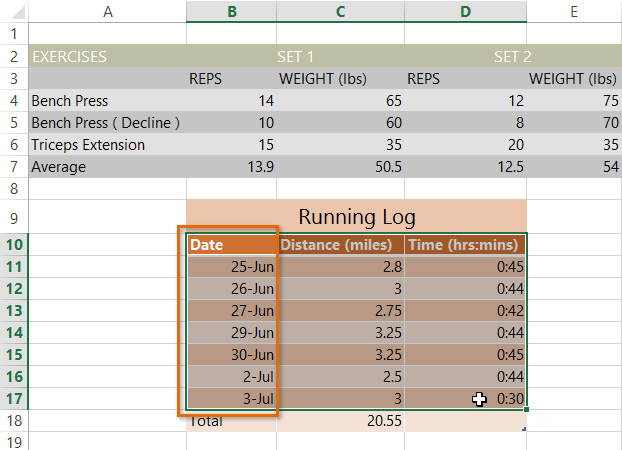 Sorting a cell range
To sort a sheet:
In our example, we'll sort a T-shirt order form alphabetically by Last Name (column C ).
-
Select a
cell
in the column you want to sort by. In our example, we'll select cell
C2
.
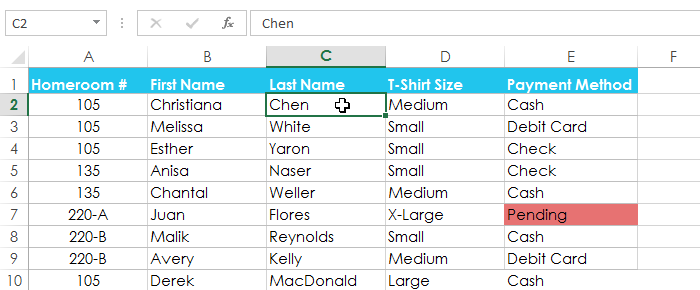 Selecting cell C2
-
Select the
Data
tab on the
Ribbon
, then click the
Ascending
command
 to Sort A to Z, or the
Descending
command
to Sort A to Z, or the
Descending
command
 to Sort Z to A. In our example, we'll click the
Ascending
command.
to Sort Z to A. In our example, we'll click the
Ascending
command.
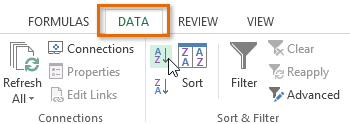 Clicking the Ascending command
-
The worksheet will be
sorted
by the selected column. In our example, the worksheet is now sorted by
last name
.
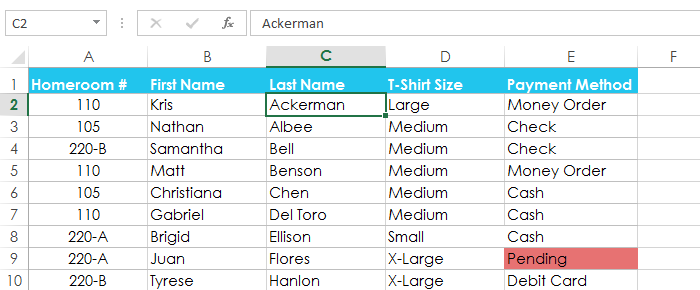 The sorted worksheet
To sort a range:
In our example, we'll select a separate table in our T-shirt order form to sort the number of shirts that were ordered on different dates.
-
Select the
cell range
you want to sort. In our example, we'll select cell range
A13:B17
.
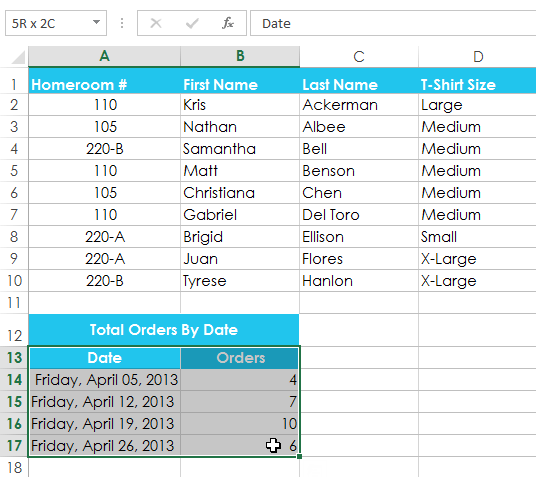 Selecting cell range A13:B17
-
Select the
Data
tab on the
Ribbon
, then click the
Sort
command.
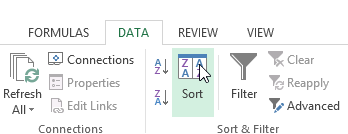 Clicking the Sort command
-
The
Sort
dialog box will appear. Choose the
column
you want to sort by. In our example, we want to sort the data by the number of T-shirt orders, so we'll select
Orders
.
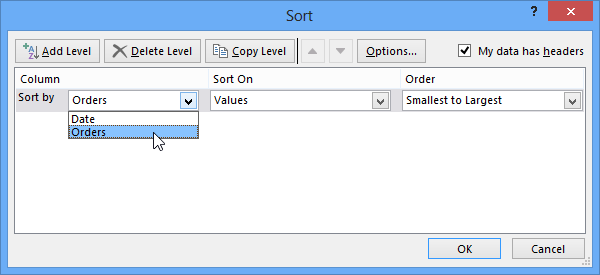 Selecting a column to sort by
- Decide the sorting order (either ascending or descending). In our example, we'll use Smallest to Largest .
-
Once you're satisfied with your selection, click
OK
.
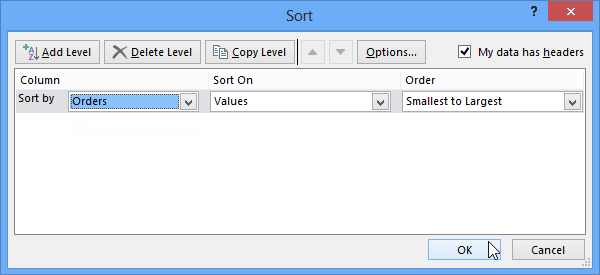 Clicking OK
-
The cell range will be
sorted
by the selected column. In our example, the Orders column will be sorted from
lowest to highest
. Notice that the other content in the worksheet was not affected by the sort.
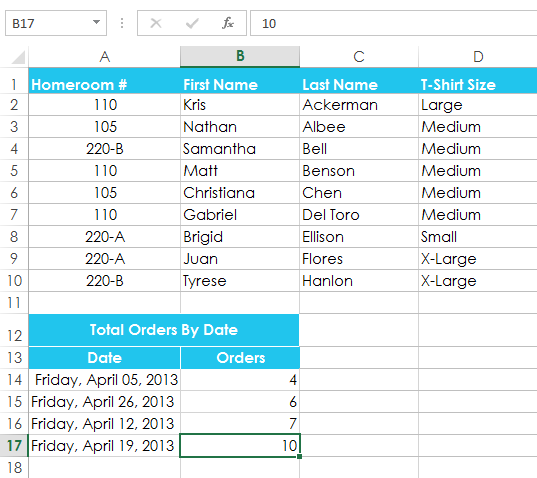 The sorted cell range
If your data isn't sorting properly, double-check your cell values to make sure they are entered into the worksheet correctly. Even a small typo could cause problems when sorting a large worksheet. In the example below, we forgot to include a hyphen in cell A18, causing our sort to be slightly inaccurate.
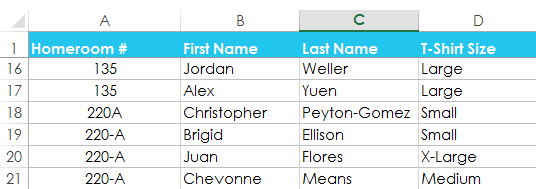 A small typo in cell A18 causing an incorrect sort
Custom sorting
Sometimes you may find that the default sorting options can't sort data in the order you need. Fortunately, Excel allows you to create a custom list to define your own sorting order.
To create a custom sort:
In our example below, we want to sort the worksheet by T-Shirt Size (column D ). A regular sort would organize the sizes alphabetically, which would be incorrect. Instead, we'll create a custom list to sort from smallest to largest.
-
Select a
cell
in the column you want to sort by. In our example, we'll select cell
D2
.
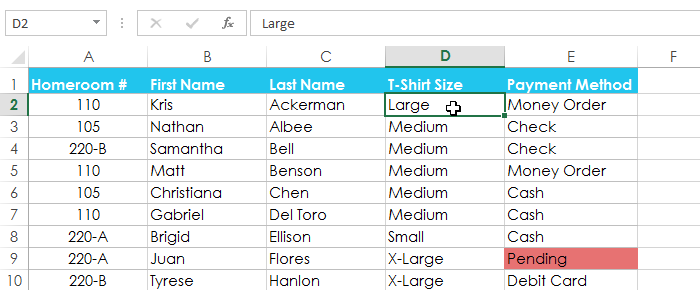 Selecting cell D2
-
Select the
Data
tab, then click the
Sort
command.
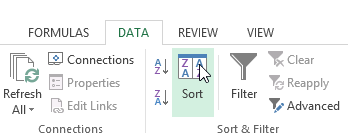 Clicking the Sort command
-
The
Sort
dialog box will appear. Select the
column
you want to sort by, then choose
Custom List...
from the
Order
field. In our example, we will choose to sort by
T-Shirt Size
.
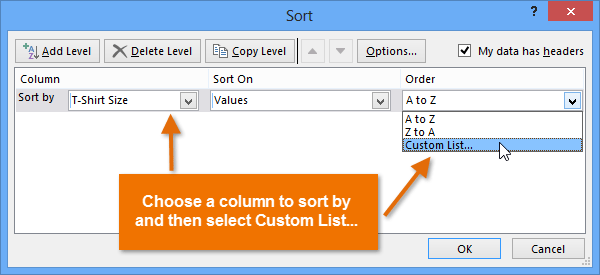 Selecting Custom List... from the Order: field
- The Custom Lists dialog box will appear. Select NEW LIST from the Custom Lists: box.
-
Type the items in the desired custom order in the
List entries:
box. In our example, we want to sort our data by T-shirt size from
smallest
to
largest
, so we'll type
Small
,
Medium
,
Large
, and
X-Large
, pressing
Enter
on the keyboard after each item.
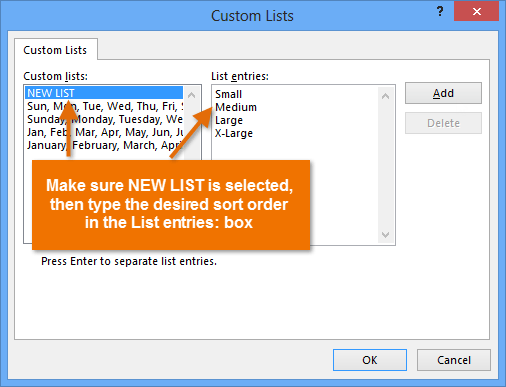 Creating a Custom list
-
Click
Add
to save the new sort order. The new list will be added to the
Custom lists:
box. Make sure the new list is
selected
, then click
OK
.
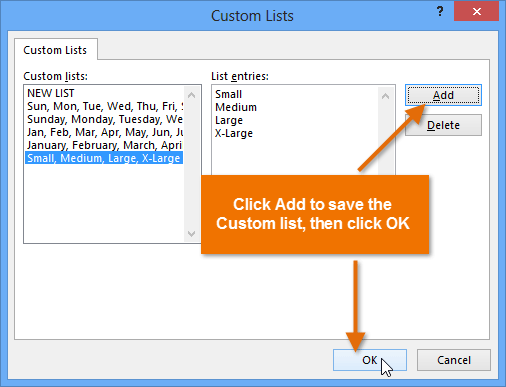 Clicking OK to select the custom list
-
The
Custom Lists
dialog box will close. Click
OK
in the
Sort
dialog box to perform the custom sort.
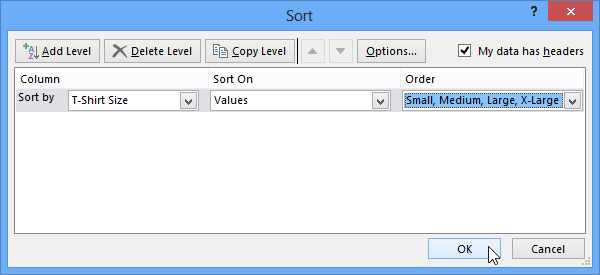 Clicking OK to sort the worksheet
-
The worksheet will be
sorted
by the custom order. In our example, the worksheet is now organized by T-shirt size from smallest to largest.
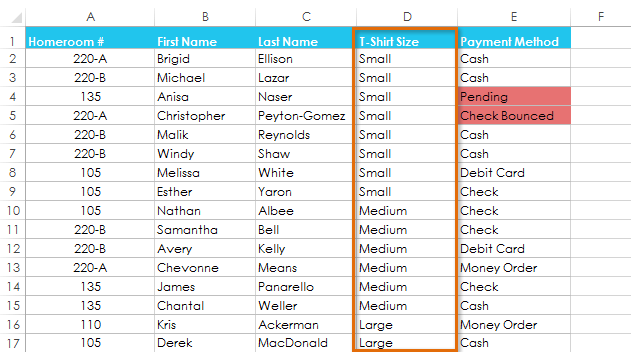 The worksheet sorted by t-shirt size
To sort by cell formatting:
You can also choose to sort your worksheet by formatting rather than cell content. This can be especially helpful if you add color coding to certain cells. In our example below, we'll sort by cell color to quickly see which T-shirt orders have outstanding payments.
-
Select a
cell
in the column you want to sort by. In our example, we'll select cell
E2
.
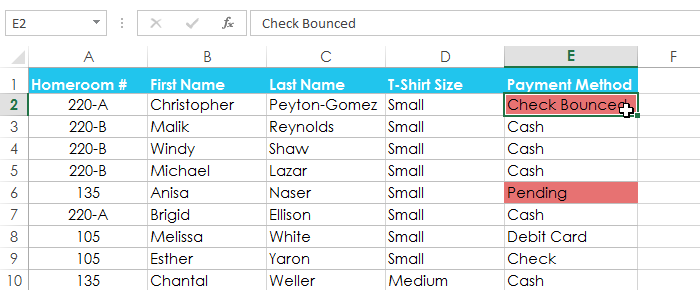 Selecting cell E2
-
Select the
Data
tab, then click the
Sort
command.
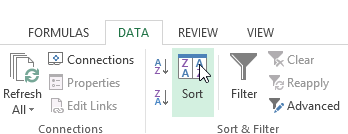 Clicking the Sort command
-
The
Sort
dialog box will appear. Select the column you want to sort by, then decide whether you'll sort by
Cell Color
,
Font
Color
, or
Cell
Icon
from the
Sort On
field. In our example, we'll sort by
Payment Method
(column
E
) and
Cell Color
.
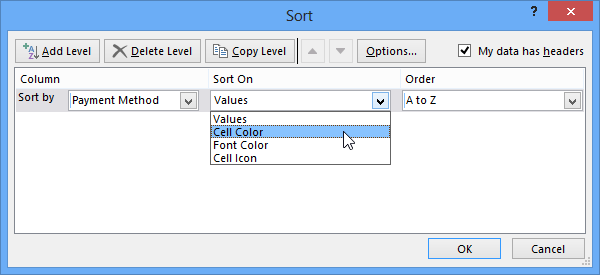 Choosing to sort by cell color
-
Choose a
color
to sort by from the
Order
field. In our example, we'll choose
light red
.
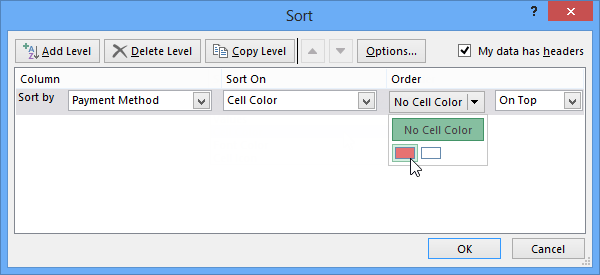 Choosing a cell color to sort by
-
Click
OK
. In our example, the worksheet is now sorted by
cell color
, with the light red cells on top. This allows us to see which orders still have outstanding payments.
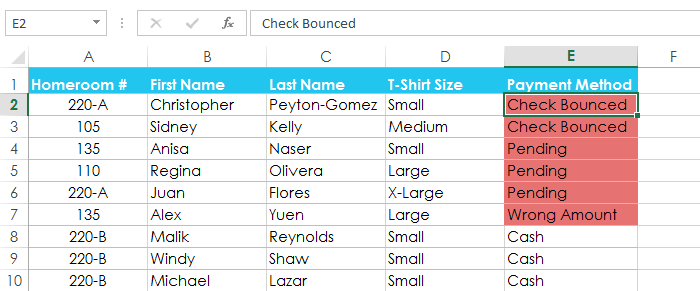 The worksheet sorted by cell color
Sorting levels
If you need more control over how your data is sorted, you can add multiple levels to any sort. This allows you to sort your data by more than one column .
To add a level:
In our example below, we'll sort the worksheet by Homeroom Number (column A ), then by Last Name (column C ).
-
Select a
cell
in the column you want to sort by. In our example, we'll select cell
A2
.
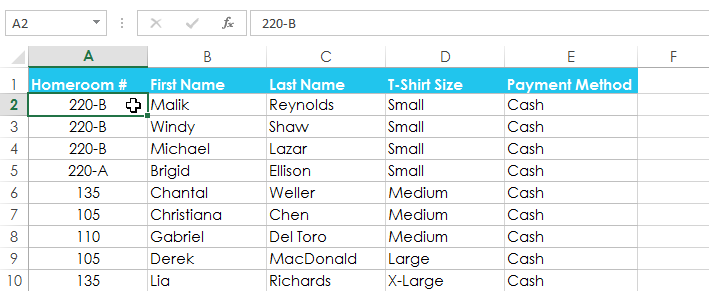 Selecting cell A2
-
Click the
Data
tab, then select the
Sort
command.
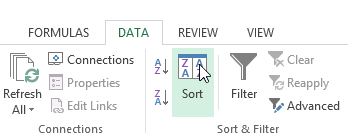 Clicking the Sort command
- The Sort dialog box will appear. Select the first column you want to sort by. In this example, we will sort by Homeroom # (column A ).
-
Click
Add Level
to add another column to sort by.
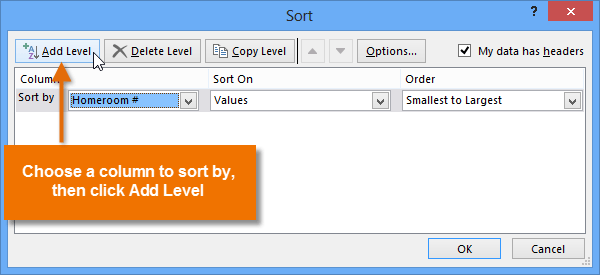 Clicking Add Level
-
Select the next column you want to sort by, then click
OK
. In our example, we'll sort by
Last
Name
(column
C
).
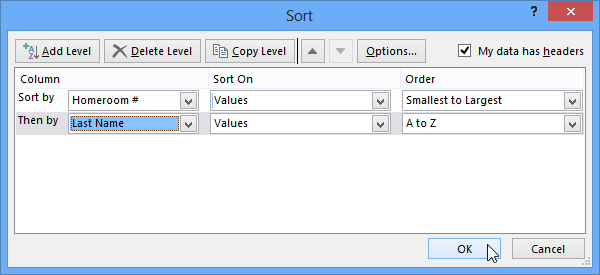 Sorting by Homeroom # and Last Name
-
The worksheet will be
sorted
according to the selected order. In our example, the homeroom numbers are sorted numerically. Within each homeroom, students are sorted alphabetically by last name.
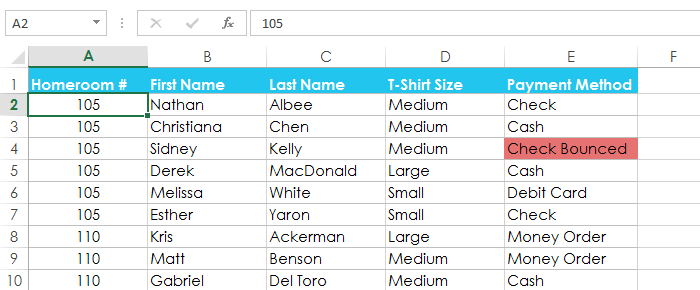 The worksheet sorted by homeroom number and last name
If you need to change the order of a multilevel sort, it's easy to control which column is sorted first. Simply select the desired column , then click the Move Up or Move Down arrow to adjust its priority.
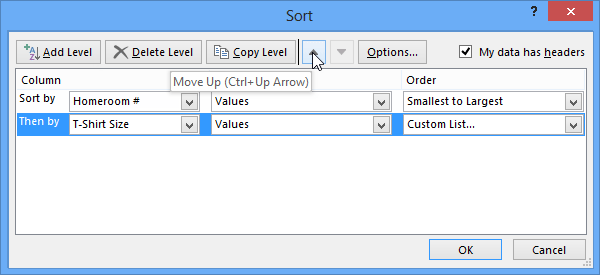 Changing the sorting priority for a column
Challenge!
- Open an existing Excel workbook. If you want, you can use our practice workbook .
-
Sort
a worksheet
in ascending
 or descending
 order. If you are using the example, sort by
Homeroom #
(column
A
).
order. If you are using the example, sort by
Homeroom #
(column
A
).
- Sort a cell range . If you are using the example, sort the cell range in the cell range G3:H7 from highest to lowest by Orders (column H ).
- Add a level to the sort, and sort it by cell color , font color , or cell icon . If you are using the example, add a second level to sort by cell color in column E .
- Add another level, and sort it using a custom list . If you are using the example, create a custom list to sort by T-Shirt Size (column D ) in the order of Small, Medium, Large, and X-Large.
-
Change the
sorting priority
. If you are using the example, reorder the list to sort by
T-Shirt Size
(column
D
),
Homeroom #
(column
A
), and
Last Name
(column
C
).