Excel 2010
Cell Basics

Introduction
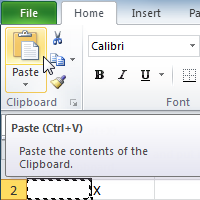
You will need to know the basic ways you can work with cells and cell content in Excel to be able to use it to calculate, analyze, and organize data. In this lesson, you will learn how to select cells , insert content , and delete cells and cell content . You will also learn how to cut , copy , and paste cells ; drag and drop cells ; and fill cells using the fill handle.
Introduction to cells and cell content
Cells are the basic building blocks of a worksheet. They can contain a variety of content such as text , formatting attributes , formulas , and functions . To work with cells, you'll need to know how to select them, insert content , and delete cells and cell content .
Optional: You can download this example for extra practice.
The cell
Each rectangle in a worksheet is called a cell . A cell is the intersection of a row and a column .
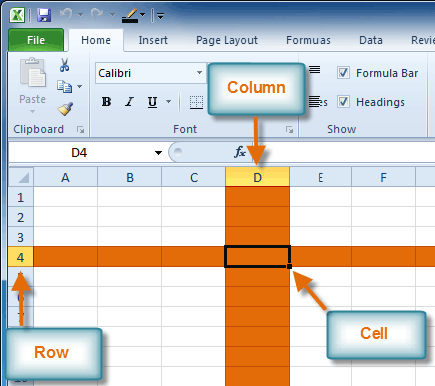 Row 4, Column D
Each cell has a name, or a cell address based on which column and row it intersects. The cell address of a selected cell appears in the name box . Here, you can see that C5 is selected.
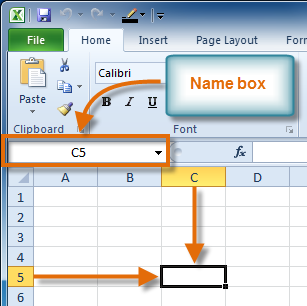 Cell address
You can also select multiple cells at the same time. A group of cells is known as a cell range . Rather than a single cell address, you will refer to a cell range using the cell addresses of the first and last cells in the cell range, separated by a colon . For example, a cell range that included cells A1, A2, A3, A4, and A5 would be written as A1:A5 .
If the columns in your spreadsheet are labeled with numbers instead of letters, you'll need to change the default reference style for Excel. Review our Extra on What are Reference Styles? to learn how.
To select a cell:
-
Click a cell
to select it. When a cell is selected, you will notice that the
borders
of the cell appear bold
 and the
column heading
and
row heading
of the cell are highlighted.
and the
column heading
and
row heading
of the cell are highlighted.
- Release your mouse. The cell will stay selected until you click another cell in the worksheet.
You can also navigate your worksheet and select a cell by using the arrow keys on your keyboard.
To select multiple cells:
-
Click and drag your mouse
until all of the adjoining cells you want are highlighted.
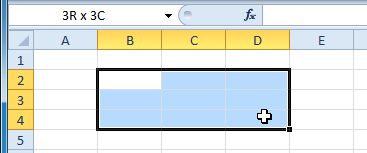 Selecting multiple cells
- Release your mouse. The cells will stay selected until you click another cell in the worksheet.
Cell content
Each cell can contain its own text, formatting, comments, formulas, and functions.
-
Text
Cells can contain letters, numbers, and dates. -
Formatting attributes
Cells can contain formatting attributes that change the way letters, numbers, and dates are displayed. For example, dates can be formatted as MM/DD/YYYY or M/D/YYYY. -
Comments
Cells can contain comments from multiple reviewers. -
Formulas and functions
Cells can contain formulas and functions that calculate cell values. For example, SUM(cell 1, cell 2...) is a formula that can add the values in multiple cells.
To insert content:
- Click a cell to select it.
-
Enter content into the selected cell using your keyboard. The content appears in the
cell
and in the
formula bar
. You can also enter or edit cell content from the formula bar.
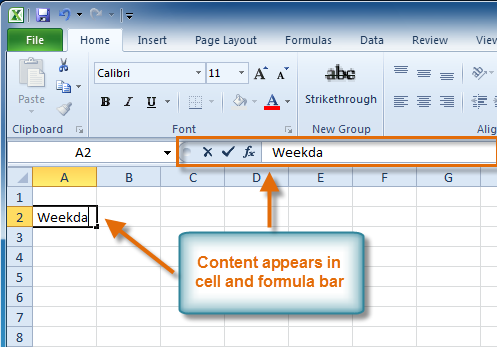 Inserting content
To delete content within cells:
- Select the cells containing content you want to delete.
- Click the Clear command on the Ribbon. A dialog box will appear.
-
Select
Clear Contents
.
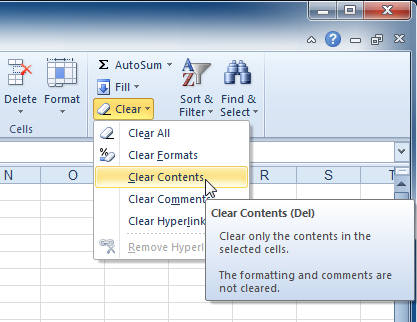 Clearing cell contents
You can also use your keyboard's Backspace key to delete content from a single cell or the Delete key to delete content from multiple cells .
To delete cells:
- Select the cells you want to delete.
-
Choose the
Delete
command from the Ribbon.
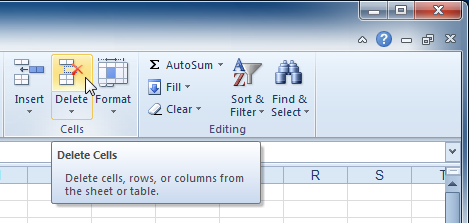 Deleting cells
There's an important difference between deleting the content of a cell and deleting the cell itself . If you delete the cell, by default the cells underneath it will shift up and replace the deleted cell.
To copy and paste cell content:
- Select the cells you want to copy.
-
Click the
Copy
command. The border of the selected cells will change appearance.
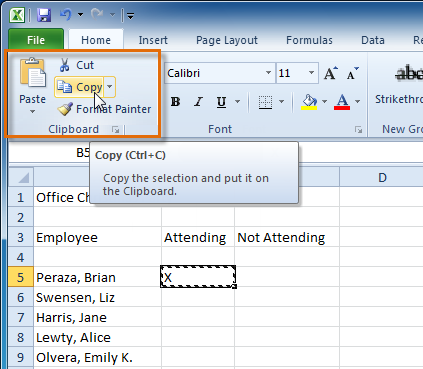 Copying selected cells
- Select the cell or cells where you want to paste the content.
-
Click the
Paste
command. The copied content will be entered into the highlighted cells.
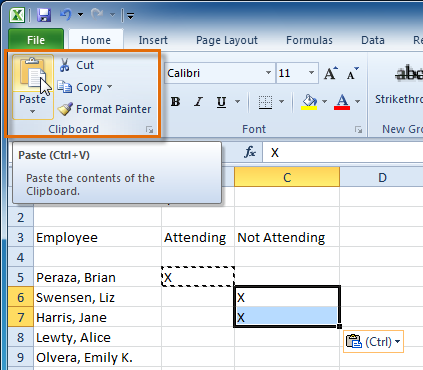 Pasting selected cells
To cut and paste cell content:
- Select the cells you want to cut.
-
Click the
Cut
command. The border of the selected cells will change appearance.
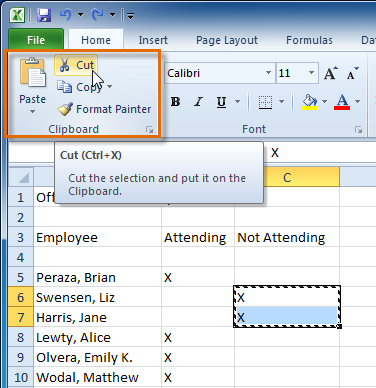 Cutting selected cells
- Select the cells where you want to paste the content.
-
Click the
Paste
command. The cut content will be removed from the original cells and entered into the highlighted cells.
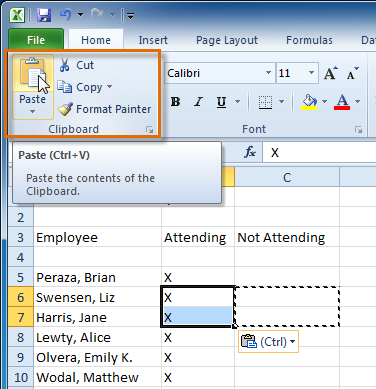 Pasting selected cells
To access more paste options:
There are more Paste options you can access from the drop-down menu on the Paste command. These options may be convenient to advanced users who are working with cells that contain formulas or formatting .
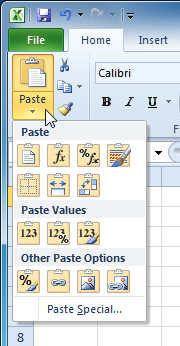 Accessing Paste Options
To access formatting commands by right-clicking:
- Select the cells you want to format.
-
Right-click
the selected cells. A
dialog box
will appear where you can easily access many commands on the Ribbon.
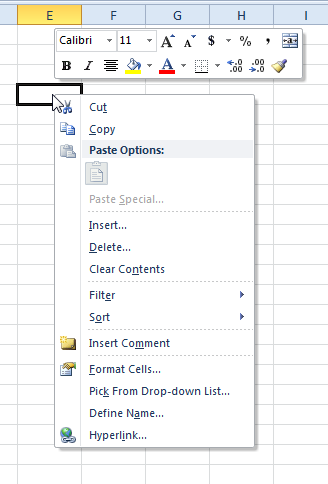 Right-clicking a selected cell
To drag and drop cells:
- Select the cells you want to move.
-
Position your mouse on one of the
outside edges
of the selected cells. The mouse changes from a
white cross
 to a
black cross with 4 arrows
to a
black cross with 4 arrows
 .
.
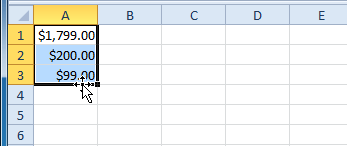 Positioning the mouse to drag and drop cells
- Click and drag the cells to the new location.
-
Release your mouse, and the cells will be dropped there.
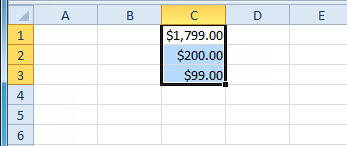 Dropped cells
To use the fill handle to fill cells:
- Select the cell or cells containing the content you want to use. You can fill cell content either vertically or horizontally.
-
Position your mouse over the
fill handle
so the
white cross
 becomes a
black cross
becomes a
black cross
 .
.
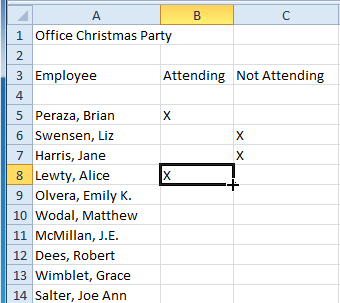 Positioning the mouse to use the fill handle
- Click and drag the fill handle until all of the cells you want to fill are highlighted .
-
Release the mouse, and your cells will be filled.
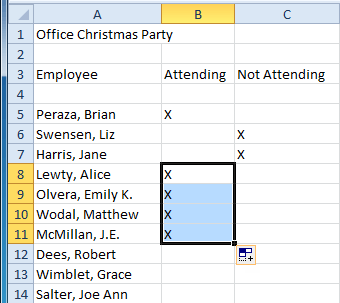 Filled cells
You can also
double-click
the fill handle instead of clicking and dragging. This can be useful with larger spreadsheets, where clicking and dragging may be awkward.
Watch the video below to see an example of double-clicking the fill handle.
Challenge!
- Open an existing Excel 2010 workbook . If you want, you can use this example .
- Select D3 , and notice how its cell address appears in the name box and its content appears in the formula bar.
- Try inserting text and numbers .
- Use the fill handle to fill in data to adjoining cells both vertically and horizontally.
- Cut cells and paste them into a different location.
- Delete a cell, and note how the content underneath it shifts up to fill its place.
- Try dragging and dropping some cells to other parts of the worksheet.